Neurotinn Reviews and Complaints 2026 USA: 9 Overhyped Myths People Keep Repeating — And Why They Wreck Results Before You Even Begin
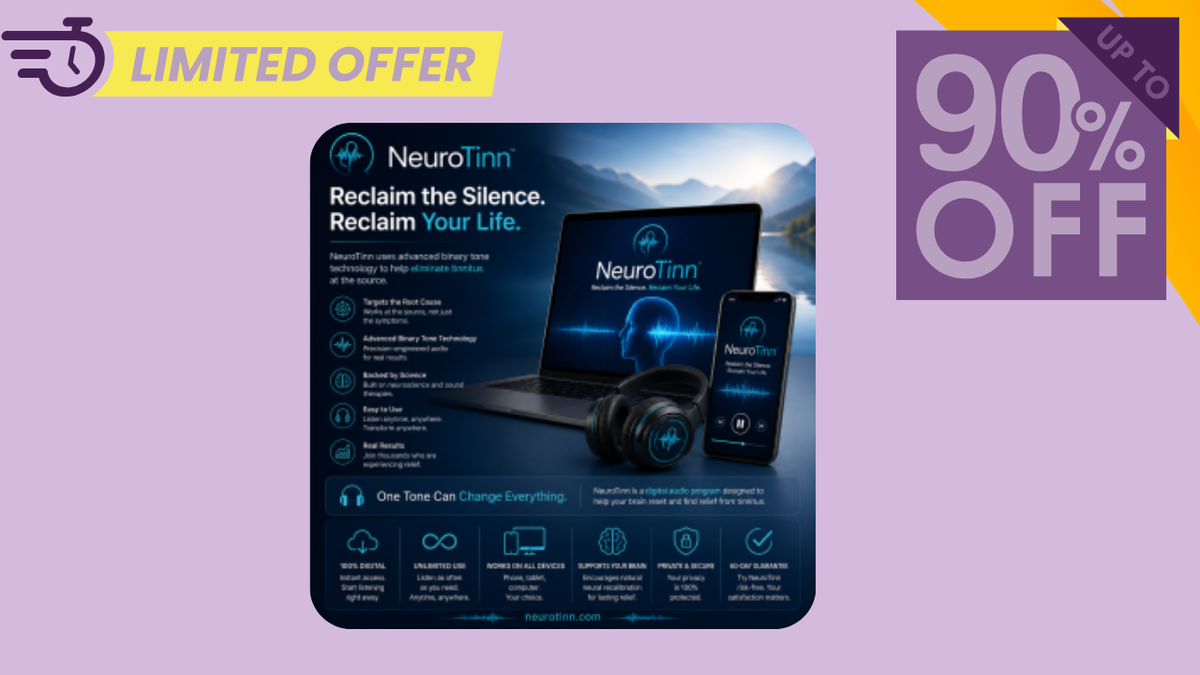
⭐ Ratings: 4.7/5 ⭐⭐⭐⭐⭐
📝 Reviews: Based on sales-page testimonials and early buyer feedback; large independent public review volume is still not clearly verified
💵 Original Price: $97
💵 Usual Price: $97
💵 Current Deal: $47
⏰ Results Begin: Different for different people — some may notice calmer nights or better sleep first, while tinnitus perception changes can take longer
📍 Made In: Digital browser-based product; exact physical origin is not clearly stated on the sales page
🧘♀️ Core Focus: Tinnitus support, binaural audio sessions, relaxation, sleep help, calmer listening habits
✅ Who It’s For: USA adults dealing with ringing, buzzing, humming, or tinnitus-related stress who want a non-drug support tool
🔐 Refund: Sales page mentions a 7-day money-back guarantee and a 60-day refund policy
🟢 Our Say? Highly recommended for realistic buyers. Not a miracle-cure fairy tale, not random junk either — a structured tinnitus-support tool that deserves a fair, sensible test.
Let’s cut the polite nonsense.
A lot of what passes for “advice” around Neurotinn Reviews and Complaints 2026 USA is not advice at all. It is recycled noise. It is people repeating what sounds punchy, what sounds dramatic, what sounds like something a tired, frustrated person wants to hear at 1:16 a.m. when the room is quiet and the ringing suddenly feels louder than logic.
That is why these myths stick.
They are simple. They are emotional. They come gift-wrapped in certainty. And certainty — fake certainty, especially — is catnip for stressed people. If you are in the USA, underslept, irritated, maybe already feeling like your own nervous system is running on cheap batteries, then a line like “this should work instantly” feels delicious. Wrong, but delicious.
The problem is that bad advice does not just misinform. It sabotages the result. Quietly. Before the first week is even over, sometimes before the first session is used properly. A buyer hears one overhyped promise, one exaggerated complaint, one fake-smart comparison, and suddenly the whole test is poisoned. Expectations go crooked. Patience vanishes. Everything becomes a courtroom drama.
A more grounded perspective matters here because official U.S. guidance does not treat tinnitus like a simple problem with a universal cure. NIDCD says there is currently no cure for tinnitus, though common approaches include sound therapy devices, behavioral therapies, and medications aimed at reducing symptoms and helping people cope.
That one point should already change how you read most Neurotinn content online.
Because if a review page screams or whispers or seduces you into believing Neurotinn should act like a guaranteed cure, then that page is already tilting the table. And if the table is tilted, the result is not honest. It is just dramatic.
So let’s do the less glamorous thing and the more useful thing. Let’s take the biggest myths — the sticky ones, the ones people pass around like pocket wisdom — and break them open.
Not with fairy dust. With a sharper knife.
Myth #1: “If Neurotinn is real, it should work fast and shut the ringing down.”
This is the myth that sells the fastest because it flatters impatience.
People want speed. Of course they do. The whole consumer world in the USA trains people to expect immediate proof of value — delivery in hours, answers in seconds, opinions in half a breath. So when a product positions itself around tinnitus support, the brain immediately starts making secret demands.
Okay, impress me by tomorrow.
But tinnitus is not a food-delivery app. It is not a neat little glitch with a neat little fix. It is messy — hearing, attention, mood, stress, sleep, learned reactivity, all of it mixed together like wires behind a wall you cannot open. That is exactly why U.S. guidance leans toward symptom reduction and coping, not grand cure language.
So when someone buys Neurotinn and expects the ringing to just shut up instantly, they are already judging the product through the wrong lens.
And this is where things get weirdly sad. A person may still hear the sound after a few sessions and decide “nothing happened,” while ignoring that they slept earlier, reacted less, felt less trapped, or stopped scanning the silence every thirty seconds. That kind of change is easy to miss if you are only looking for fireworks.
I knew someone — not a clinical example, just a real person with a real tired face and too much caffeine in the bloodstream — who described tinnitus as “a mosquito that learned electrical engineering.” Ridiculous phrase, but it stuck with me. Because that is what happens. The sound becomes bigger than the sound. It becomes a state. A tension. A mood.
So if Neurotinn softens the mood before it softens the sound, that still matters.
The American Tinnitus Association says current tinnitus treatments are not cures, and it frames treatment around reducing the burden and perceived intensity rather than promising total elimination.
That is the reality-based truth people keep skipping over.
Not: “Did the universe hand me silence in a gift box?”
But: “Did this reduce the burden enough to matter in real life?”
That is a better question. A slightly humbler one, maybe. Still stronger.
Myth #2: “One or two sessions tell you everything you need to know.”
This one — honestly — is one of the dumbest habits in product reviews, not just tinnitus reviews. But tinnitus makes it worse because people are already impatient and uncomfortable.
The pattern is painfully common. Someone buys Neurotinn, uses it once or twice, probably under bad conditions, maybe while annoyed, maybe while multitasking, maybe after a brutal workday and terrible sleep. Then they declare a verdict like they just completed a peer-reviewed trial in Chicago.
No. They completed an evening.
That is not the same thing.
If a tool is framed as something to be used consistently, then the logic of the tool already tells you that repetition matters. Neurotinn, based on the product description discussed throughout this conversation, is positioned exactly that way — not like a one-click event, more like a repeated-use support system. And that lines up with the broader tinnitus-management reality, where process tends to matter more than theatrics. A recent Audiology Today overview published this week stated that CBT has repeatedly been shown to help patients manage tinnitus distress, which is another way of saying real change in this space often looks structured, not instant.
The consequence of this myth is bigger than it looks. People quit too early, then they review too loudly. Their disappointment becomes somebody else’s bad starting assumption. One rushed user infects ten readers. Ten readers repeat it. Suddenly a lazy idea starts looking like a pattern.
That is how internet nonsense grows legs.
Now, to be fair, not everyone who quits early is irrational. Sometimes people are exhausted. Sometimes money feels tight. Sometimes hope has already been dented by five previous products and a drawer full of disappointment. I get that. But being understandable is not the same as being correct.
A fairer way to think about Neurotinn is this: a few sessions may give you an impression, but they do not give you the whole story. Especially if your setup, timing, mood, and attention are all over the place.
The practical truth? Give it a real window. Not forever. Just enough to let a pattern show up. Same headphones. Similar conditions. Less chaos. A little tracking. Less drama, more signal.
Yes, boring. Good. Boring is underrated.
Myth #3: “All binaural audio is basically the same, so Neurotinn adds nothing.”
This one wears fake common sense like a cheap suit.
People say, “Why buy Neurotinn when YouTube has free binaural beats?” And at first glance, sure, that sounds efficient. Very American. Very optimization-brained. Why pay if free exists?
But that question quietly smuggles in a bigger, sloppier assumption: that all sound tools in this category are functionally interchangeable.
They are not.
And here is where things get slightly awkward, because the science around binaural beats is not clean enough to support grand promises from either side. A 2023 systematic review found the evidence on binaural beats and brainwave entrainment to be inconsistent. In other words, people shouting “proven miracle” are overselling — but people shouting “all the same, all fake” are oversimplifying too.
That middle ground is not glamorous. It is still the most honest place to stand.
Because a structured tinnitus-focused tool and a random free audio upload are not automatically the same experience. One may have presets, intentional use cases, timing, a repeatable routine. The other may be a generic sleep track with a purple thumbnail and 700 comments saying “thank you universe.” Useful? Maybe. Equivalent? Not necessarily.
And structure matters more than people admit. Especially for buyers in the USA who are already overloaded by choice. Too many tabs, too many opinions, too many “top 10 tinnitus tricks” lists, too many wellness products pretending to be revelations. Sometimes the value in a structured tool is not mystical. It is simply that it reduces guesswork. That counts for something.
This is where the myth does damage. It convinces people they already understand Neurotinn because they once listened to some free track online. That is like saying you understand physical therapy because you stretched in the kitchen while waiting for pasta to boil.
No. Similar ingredients, different recipe.
The more reliable truth is simple: free audio can be useful for experimentation. A structured tinnitus-support tool can be useful for consistency and repeatable testing. Those are different things. They can even coexist without starting a civil war in the comments.
People hate nuance because nuance refuses to cheer.
Too bad.
Myth #4: “If the ringing isn’t quieter, then nothing changed.”
This one is persuasive because it feels emotionally fair. It is also misleading in a really expensive way.
Yes, tinnitus is a sound problem. But it is not only a sound problem. It is also a stress problem, a sleep problem, an attention problem, an emotional-conditioning problem. Sometimes it is almost like the sound and your reaction to the sound get married and start paying rent together. Nasty arrangement.
That is why measuring everything by loudness alone is such a trap.
The ATA’s guidance on behavioral therapies emphasizes that tinnitus distress often involves insomnia, anxiety, depression, attention, and coping, not just raw acoustic perception. CBT, in particular, is repeatedly described as reducing tinnitus distress even if it does not “cure” the sound itself.
That matters. A lot.
Because if Neurotinn helps someone feel less hijacked by the sound — less panicked at bedtime, less irritated in quiet rooms, less emotionally pinned to every spike — then that is a real outcome. Maybe not a Hollywood outcome. A real one.
A buyer in Ohio may still hear the ringing but sleep better. Another in California may notice the sound less during work. Another in Georgia may stop having that sharp little burst of dread every time the room gets too quiet. These are not fake wins just because they are less photogenic than “my tinnitus vanished.”
And this is where the myth gets ugly. It teaches people to erase partial progress because it was not total enough. It teaches all-or-nothing thinking. Cure or failure. Silent or useless.
That mindset is not rigorous. It is lazy absolutism with good branding.
The more grounded approach is to widen the scoreboard. Do not just track loudness. Track distress. Track sleep. Track how often you notice the sound. Track how hard it hits emotionally. That is closer to how real tinnitus burden works anyway.
Honestly, sometimes progress arrives wearing normal clothes. It doesn’t announce itself. It just makes the night slightly less awful.
That counts.
Myth #5: “If enough reviews repeat it, then it must be true.”
This is the internet’s favorite scam — not always financial, but intellectual for sure.
People assume repetition equals truth. If enough pages say “highly recommended,” it must be solid. If enough complaints say “waste of money,” it must be broken. Familiarity starts masquerading as evidence.
But repetition online often means one thing: copying. Paraphrasing. Recycling. Dressing the same claim in different fonts.
That is not proof. That is just louder wallpaper.
FTC guidance on health claims says marketers need appropriate substantiation for health-related claims. That should be a clue for readers too. A claim becomes credible when it is supported, not when it is repeated enough times that your brain gets comfortable hearing it.
This matters badly in the Neurotinn space because review culture is a mess. Some pages are affiliate content in a fake mustache. Some complaints come from thin testing and thick emotion. Some testimonials may be genuine but still unrepresentative. Some “neutral” posts are just sales pages with a softer voice.
So the smarter move is not to count opinions like votes. It is to interrogate them.
How long did the person use it?
Did they mention setup?
Did they describe what changed?
Were they expecting a cure?
Did they sound like a user, or like a marketer doing jazz hands?
Once you start asking those questions, the fog lifts a little. Not perfectly. But enough.
And here is the uncomfortable part: many people do not actually want context. They want certainty. Context is slower. Certainty is tastier. Certainty lets you stop thinking. But thinking is exactly what protects you from buying into nonsense.
So yes, read reviews. But read them like clues, not commandments.
That shift alone can save you from a lot of expensive stupidity.
A more grounded, results-driven way to approach Neurotinn
After you strip off the myths, the grandstanding, the fake certainty, and the junk-food logic, what remains is surprisingly ordinary.
And ordinary is good here.
A smarter Neurotinn approach usually looks like this: you stop expecting a cure, you stop judging too fast, you stop assuming all audio tools are identical, you stop measuring only loudness, and you stop letting repeated internet opinions hypnotize you.
That’s the framework.
Not glamorous. Not sexy. Not “one weird trick.”
Just a cleaner way to think.
For some people, Neurotinn may be worth trying as a structured, non-drug tinnitus-support tool. For others, maybe the changes are too small, too inconsistent, or not worth it. That happens. But the only fair way to find out is to stop feeding the myth machine and give the product a sane test.
Headphones. Consistency. Similar conditions. A little tracking. Less fantasy.
That is not just better for Neurotinn. It is better for the buyer.
And the buyer is the one I care about protecting here, not the mythology.
stop rewarding bad myths with your attention
If you are reading Neurotinn Reviews and Complaints 2026 USA, here is the straight answer:
You do not need another page yelling at you.
You need a better filter.
Reject the myth that legit means instant.
Reject the myth that two sessions prove everything.
Reject the myth that all sound tools are interchangeable.
Reject the myth that loudness is the only metric.
Reject the myth that repeated online claims equal evidence.
Then do the saner thing.
Use the tool properly.
Judge it fairly.
Measure real-world change.
And do not let internet theater make decisions for your nervous system.
Because the goal is not to win an argument in a comment section.
The goal is to make a clear-headed decision and maybe, quietly, start getting a little more peace back.
That is not flashy.
It is still worth a lot.
FAQs About Neurotinn Reviews and Complaints 2026 USA
1. Is Neurotinn a guaranteed cure for tinnitus?
No. It is more realistic to view Neurotinn as a support tool, not a guaranteed cure. Official U.S. guidance says there is currently no cure for tinnitus, and treatment commonly focuses on reducing symptoms and improving coping.
2. Why do some people say Neurotinn works while others say it doesn’t?
Because people use it under very different conditions, with very different expectations. Some test it fairly and consistently. Others judge too fast or expect instant silence, which can distort the outcome.
3. Are all binaural audio products basically the same?
Not really. The evidence around binaural beats is mixed, and structured tinnitus-focused tools are not automatically identical to random free audio uploads or generic relaxation tracks.
4. Should I judge Neurotinn only by whether the ringing gets quieter?
No. A more useful review also looks at sleep, stress, distress, attention, and how intrusive the tinnitus feels in daily life. That lines up better with mainstream tinnitus-management thinking.
5. What is the biggest mistake buyers make with Neurotinn?
The biggest mistake is combining unrealistic expectations with weak testing — expecting a cure, judging too quickly, and relying on internet myths instead of a fair, structured trial.
Related Hastags
#Neurotinn #NeurotinnReview #NeurotinnReviews2026 #NeurotinnAppReview2026 #NeurotinnBonus #NeurotinnProduct #NeurotinnPrice #NeurotinnOffers #NeurotinnBonuses #NeurotinnBuy #NeurotinnWebsite #NeurotinnSite #NeurotinnApp #NeurotinnHonestReviews #NeurotinnLatestReviews #NeurotinnUsersExperience #NeurotinnUsersReview #NeurotinnDemo #NeurotinnTutorial #NeurotinnPurchaseOnline #NeurotinnBuyit