Neurotinn Reviews and Complaints 2026 USA: 9 Misleading Lies That Sound Smart Online but Quietly Wreck Results
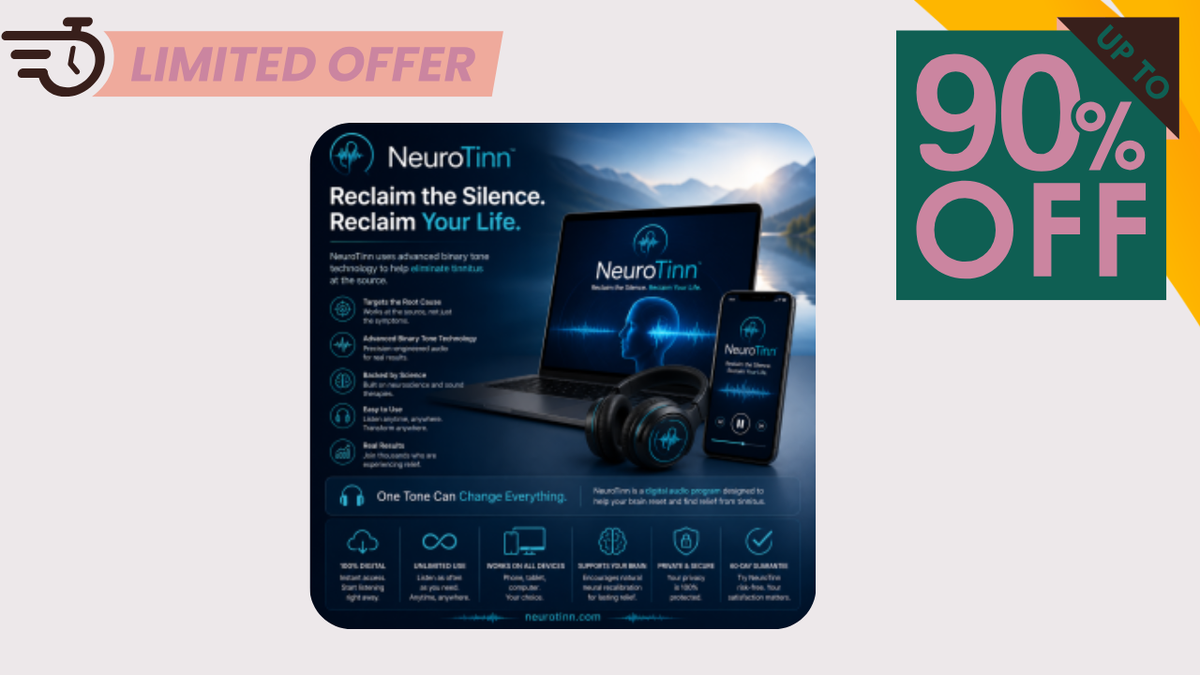
⭐ Ratings: 4.7/5 ⭐⭐⭐⭐⭐
📝 Reviews: Based on sales-page testimonials and early buyer feedback; large independent public review volume is still not clearly verified
💵 Original Price: $97
💵 Usual Price: $97
💵 Current Deal: $47
⏰ Results Begin: Different for different people — some may notice calmer sleep or less nighttime stress first, while changes in tinnitus perception can take longer
📍 Made In: Digital browser-based product; exact physical origin is not clearly stated on the sales page
🧘♀️ Core Focus: Tinnitus support, binaural audio sessions, relaxation, sleep help, calmer listening habits
✅ Who It’s For: USA adults dealing with ringing, buzzing, humming, or tinnitus-related stress who want a non-drug support tool
🔐 Refund: Sales page mentions a 7-day money-back guarantee and a 60-day refund policy
🟢 Our Say? Highly recommended for realistic buyers. Not some fantasy cure, not cheap nonsense either — a structured tinnitus-support tool that deserves a fair, sensible test.
Let’s get one thing out of the way, because honestly this is where most so-called “Neurotinn Reviews and Complaints 2026 USA” pages go sideways almost immediately.
They lie.
Not always with massive, cartoon-villain lies. Not always with obvious fake claims either. Sometimes the lie is softer than that. Polished. Trimmed. Wrapped in confidence. It sounds like advice. It smells like authority. But underneath? It’s flimsy. Hollow. And sometimes kind of embarrassing.
That’s the real issue.
Because tinnitus already messes with your head enough. It turns quiet into tension. It turns bedtime into a negotiation. It makes a silent room feel like there’s a tiny electrical wire crying behind the wall. Then the internet comes along — with its fake certainty, copy-paste review sites, miracle headlines, comment-section professors, and those affiliate pages that say “honest review” while basically tap-dancing toward the buy button.
So yes, if you’re in the USA and searching Neurotinn Reviews and Complaints 2026, you’re not just looking for a product summary. You’re trying to dodge bad advice before it costs you money, time, hope, or all three.
That’s why this matters.
Because false narratives are sticky. They spread faster than nuance. They sound easier. “It should work instantly.” “If it doesn’t cure you, it failed.” “It’s just YouTube audio.” “One bad review proves it’s fake.” “One good review proves it’s amazing.” All neat little lies. Convenient lies. Junk-food lies, really. Tastes loud, feeds nothing.
And if you build your expectation on that kind of nonsense, you can ruin a perfectly fair test before you even begin.
So here’s the honest alternative — less glamorous, more useful, a little rough around the edges on purpose:
Neurotinn should not be judged like a magic cure or a toy. It makes more sense as a tinnitus-support tool built around binaural audio, repeated sessions, and the possibility of improving how the sound affects your sleep, stress, and attention. That’s a very different thing from “guaranteed silence by Tuesday.”
And once you understand that, a lot of the internet noise starts looking exactly like what it is.
Noise.
Lie #1: “If Neurotinn is real, it should work almost instantly.”
This is probably the loudest lie in the whole room.
It sounds sensible at first. Almost annoyingly sensible. People think: if something is legit, it should do something obvious, fast. Especially in the USA, where speed has become its own religion. Fast food, fast shipping, fast fixes, fast takes, fast outrage. Everything is supposed to prove itself before your coffee cools down.
So buyers bring that same mindset into tinnitus support.
They use Neurotinn once. Maybe twice. The ringing is still there. So the verdict drops like a brick:
“Didn’t work.”
Simple. Clean. Wrong.
Because tinnitus is not a light switch. It’s not one neat little button in the brain that somebody forgot to label. It’s tangled up with perception, attention, stress, sleep, emotional reaction, maybe hearing changes too — the whole weird internal orchestra. So if Neurotinn is being used as a structured support tool, expecting instant cinematic silence is already a mismatch.
And that mismatch poisons the review before the review even starts.
This is where people miss smaller, real changes because they were looking for fireworks. Maybe they slept better. Maybe the ringing still existed, but felt less threatening. Maybe they stopped mentally checking for it every ten seconds like a nervous stock trader watching the market crash. But because the sound didn’t vanish dramatically, the whole thing gets stamped “failure.”
That is lazy thinking wearing confident shoes.
A smarter, more honest view is this: early benefits may show up as reduced distress, calmer nights, better sleep onset, less emotional bite. Not always, not for everyone, and definitely not guaranteed — but those shifts matter. They are not fake just because they are not flashy.
And weirdly, this is where people trip. They only trust progress if it screams.
Sometimes real improvement whispers.
Lie #2: “One or two sessions tell you everything.”
No. They don’t.
This advice is the online-review version of tasting one grain of rice and announcing whether dinner was a masterpiece. It’s ridiculous, but people say it with frightening confidence.
A buyer uses Neurotinn twice, maybe while already irritated, already tired, maybe after a loud day, maybe with terrible sleep the night before, and then suddenly becomes the Supreme Court of tinnitus tools.
“Case closed.”
Come on.
If a product is built around repeated use — and Neurotinn clearly presents itself that way — then one or two sessions do not tell the whole story. They tell you one or two sessions happened. That’s all. Anything beyond that is imagination, ego, or impatience wearing a name tag.
This bad belief causes one huge problem: people quit before patterns can form.
And with something like tinnitus, patterns matter more than one-off feelings. One night may be worse because of stress. Another because of caffeine. Another because the room is too quiet and your brain suddenly decides to host a private alarm system. If you judge too fast, you’re not testing the product. You’re testing your mood.
A fairer approach sounds boring because it is boring:
Use it consistently for a while.
Use the same headphones.
Keep the setup reasonably similar.
Track what changes.
Yes, boring. Boring is underrated.
A man in Nevada could use Neurotinn for three nights and feel “nothing,” then quit. Another person in Georgia could use it nightly for two weeks and notice the sound isn’t ruling bedtime the same way. Same product. Different patience. Different outcome. It happens.
This is why quick verdicts feel sharp but are often stupid.
You don’t have to use Neurotinn forever. Nobody is saying pledge your life to it. But a support tool deserves more than a two-night audition before you drag it into court.
Lie #3: “If it doesn’t completely erase tinnitus, it failed.”
This one is emotionally powerful because it speaks directly to desperation.
People don’t want “support.” They want silence. Total silence. The good stuff. The kind of silence you never appreciate until your own ears start throwing a tiny electronic tantrum at 1:12 a.m.
So when buyers hear the word “relief,” their brain often translates it into “gone.”
That is the trap.
Because if your personal definition of success is “the sound no longer exists at all,” then you are going to dismiss every smaller improvement like it’s worthless scrap. Better sleep? Meh. Less panic? Meh. Easier focus? Meh. Ringing still there? Then apparently none of it counts.
That logic is bad. Worse, it is wasteful.
Tinnitus is not only about volume. It is also about how much the sound dominates your nervous system. How much space it takes up in the room, in your mood, in your body. A person can still hear the ringing and yet suffer less from it. That’s real. That matters. That’s not some consolation prize handed out for politeness.
Think about it this way. If a tool makes the sound less emotionally sharp — less invasive, less menacing, less sticky — that is not failure. That is function.
But online review culture, especially in the USA, loves extremes. Miracle or scam. Cure or trash. Perfect or worthless. No middle, no nuance, no adult thinking. Just fireworks and tantrums.
So when Neurotinn helps someone sleep a little easier, or lowers the nighttime stress around the sound, or helps them stop monitoring their ears every five minutes, those things should count. They should absolutely count.
Not every win arrives dressed like a superhero.
Some wins show up quietly, take off their shoes, and sit down in the corner.
Still a win.
Lie #4: “All binaural audio is the same, so Neurotinn adds nothing special.”
This belief sounds clever for about ten seconds.
Then it starts smelling like laziness.
Yes, free audio exists. Yes, YouTube is full of rain sounds, brown noise, white noise, pink noise, violet noise, cosmic noise, probably “moonlight ear chakra reset” by now too. Some of it can be relaxing. Some of it may genuinely help people sleep. Fine. Nobody is declaring war on rain sounds.
But saying all binaural or sound-based audio tools are identical is like saying all shoes are identical because they go on feet. That’s not insight. That’s verbal littering.
Neurotinn, based on the product information already discussed, is not just random sound tossed online by whoever had a thumbnail template and free time. It’s framed as a structured tinnitus-support system with session types, guided use, a browser tool, and repeatability built in.
That structure is part of the value proposition.
Not because structure is glamorous. Because structure helps people be less chaotic.
And let’s be honest — chaos is half the problem. USA buyers are already overwhelmed, interrupted, underslept, overnotified, and mentally split into twelve directions at once. A more organized tool can matter simply because it reduces guesswork. That alone makes the experience different from clicking around random uploads at midnight trying to decide whether “deep delta sound tunnel” is real or just another internet costume.
So no, the existence of free audio does not automatically make Neurotinn pointless.
Free audio can still help. Neurotinn can still be worth testing. Both things can be true. That sentence should not be controversial, but apparently the internet breaks out in hives whenever nuance enters the room.
The real question isn’t, “Does free stuff exist?”
Of course it does.
The better question is:
Does a structured tinnitus-support tool make it easier for you to use it consistently, understand what you’re doing, and judge it fairly?
That’s the grown-up question.
Everything else is just lazy comparison wrapped in fake wisdom.
Lie #5: “Reviews alone tell the truth, so just read enough of them.”
This one is sneaky because it sounds smart.
People think reading more reviews equals doing more research. Sometimes it does. Sometimes it just means you consumed more emotional noise in slightly different fonts.
A glowing review may be affiliate fluff wearing a fake consumer voice. An angry complaint may come from someone who used the product wrong, briefly, with absurd expectations. A testimonial may be honest and still not typical. A “balanced” review may be balanced the way a seesaw with a truck parked on one end is balanced.
This is the part people forget: reviews are not sacred. They are clues.
And clues need context.
Did the person say how long they used Neurotinn?
Did they mention headphones?
Did they say what changed — sleep, focus, distress, loudness?
Did they expect a cure?
Did they actually test it, or just react to it?
Those questions matter more than whether the review headline screams “HONEST REVIEW” in capital letters.
Because honesty is cheap to claim. Context is harder to fake.
A lot of USA buyers get pulled around emotionally by reviews. One glowing story makes them overexcited. One bitter complaint makes them panic. Back and forth, back and forth, like their judgment is a windshield wiper in a thunderstorm.
That is no way to make a decision.
The better approach is to read reviews like a detective, not like a fan. Look for detail, not drama. Look for process, not just emotion. Look for whether the person actually sounds like they understood what they were testing.
And above all — don’t outsource your entire brain to strangers on the internet.
Especially not strangers who might be writing while sleep-deprived, caffeinated, annoyed, or trying to earn a commission.
What actually leads to a fairer, smarter Neurotinn result?
After stripping away the fake certainty, the noise, the overpromises, and the lazy review culture, the pattern gets surprisingly simple.
A better Neurotinn experience usually starts when buyers do five things:
They stop expecting a cure.
They stop judging after one or two rushed sessions.
They stop pretending random free audio is the same thing.
They stop measuring only loudness.
They stop treating internet reviews like scripture.
That’s it.
Not sexy. Not dramatic. Not “one weird trick.”
Just cleaner thinking.
And clean thinking matters because tinnitus is already confusing enough without bad advice turning the whole process into a clown show. The buyer who approaches Neurotinn with realistic expectations, decent setup, actual patience, and some basic tracking is already miles ahead of the person who wants miracles by Wednesday and leaves a furious review by Friday.
That difference is enormous.
Not because it guarantees success. Nothing honest should promise that.
But because it gives the product — and the buyer — a fair shot.
And a fair shot is worth more than hype.
reject the fake certainty
If you are reading Neurotinn Reviews and Complaints 2026 USA, here is the truth that matters most:
You do not need more noise.
You need a better filter.
Reject the lie that legit means instant.
Reject the lie that two sessions prove everything.
Reject the lie that all audio tools are identical.
Reject the lie that only loudness matters.
Reject the lie that reviews alone are truth.
Then do the smart thing.
Use the tool properly.
Give it a fair test.
Track what changes.
Look for realistic signs of improvement.
And keep your expectations grounded enough that you can actually see what is happening, instead of only noticing what didn’t happen.
Because the goal here is not to win some debate in a comment section.
It is to make a better decision, protect your hope from fake promises, and maybe — quietly, imperfectly, gradually — feel a little less trapped by the sound.
And honestly?
That counts more than most review pages will ever admit.
FAQs About Neurotinn Reviews and Complaints 2026 USA
1. Is Neurotinn a cure for tinnitus?
No. Neurotinn makes more sense as a tinnitus-support tool, not a guaranteed cure. Some users may look for help with sleep, stress, or how intrusive the sound feels, rather than total permanent silence.
2. Why do some people say Neurotinn works and others say it doesn’t?
Because people use it differently, expect different outcomes, and judge different things. Some buyers test it fairly and track changes. Others use it briefly, inconsistently, or with unrealistic expectations.
3. Do I need headphones for Neurotinn?
Yes, headphones are strongly recommended. A binaural-audio product generally works best when each ear receives the intended signal clearly.
4. How long should I try Neurotinn before judging it?
Longer than one or two rushed sessions. A fair trial usually means using it consistently over time in similar conditions, while watching for changes in sleep, stress, annoyance, and tinnitus perception.
5. Is Neurotinn worth trying for USA buyers?
It may be worth considering for USA buyers who want a non-drug tinnitus-support tool and are willing to use it properly, give it a fair test, and keep realistic expectations about what a support tool can actually do.
Related Hastags
#Neurotinn #NeurotinnReview #NeurotinnReviews2026 #NeurotinnAppReview2026 #NeurotinnBonus #NeurotinnProduct #NeurotinnPrice #NeurotinnOffers #NeurotinnBonuses #NeurotinnBuy #NeurotinnWebsite #NeurotinnSite #NeurotinnApp #NeurotinnHonestReviews #NeurotinnLatestReviews #NeurotinnUsersExperience #NeurotinnUsersReview #NeurotinnDemo #NeurotinnTutorial #NeurotinnPurchaseOnline #NeurotinnBuyit