Lymph Flow Reviews & Complaints USA: 5 Overhyped Myths, 3 Price Traps—and 1 Truth Most Review Sites Conveniently Ignore
⭐ Official Website Rating Claim: 4.91/5 — displayed by the seller, not an independently audited clinical score.
📝 Reviews: The official site says Lymph Flow is trusted by thousands of customers. An exact independently verified review total is not clearly published, so those “20,000 glowing reviews” headlines should not be treated as fact without evidence.
💵 Regular Advertised Price: $129 per bottle.
💵 Two-Bottle Deal: $158 total — $79 per bottle, with a small shipping fee.
💵 Three-Bottle Deal: $207 total — $69 per bottle, with free USA shipping advertised.
💵 Six-Bottle Deal: $294 total — $49 per bottle, with free USA shipping advertised.
⏰ Results Begin: The seller says many customers report noticing a difference within two to three weeks. That is a company-reported estimate—not a guaranteed result for every buyer.
📍 Made In: USA, according to the manufacturer.
🧘♀️ Core Focus: Supporting normal lymphatic drainage, circulation, fluid balance, and everyday physical comfort.
✅ Who It’s For: Adults interested in an alcohol-free botanical liquid supplement who understand that “supports” does not mean “cures.”
🔐 Refund: 60 days through ClickBank. The published policy says customers do not need to return the bottles, but the guarantee is available only once per customer relationship.
🟢 Our Say: Lymph Flow appears to be a real, purchasable supplement with an active storefront, a visible ingredient label, published package prices, and a written refund process. I like what can be verified. Highly recommended for thoughtful consideration—yes. “Guaranteed miracle with zero limitations”? Put the trumpet away.
Health disclaimer: Lymph Flow is a dietary supplement. It is not presented here as a treatment for edema, lymphedema, heart disease, kidney disease, or any diagnosed medical condition.
Why Lymph Flow Myths Spread Faster Than Common Sense
Bad advice rarely introduces itself as bad advice.
It doesn’t knock politely and say, “Hello, I’m a misleading oversimplification that may cause you to waste money.”
No.
It barges through the door wearing sunglasses, carrying five gold stars, and yelling:
“This changed my entire body in four days!”
Entire body?
Your ankles, digestion, personality, credit score...
The internet has made supplement research feel like a noisy flea market where every person owns a megaphone. Search “Lymph Flow reviews and complaints USA” and you will probably encounter two opposing tribes.
One tribe says Lymph Flow is basically bottled perfection.
The other acts as though ordering herbal drops will cause federal agents to crash through the ceiling.
Both sides are exhausting.
And neither helps the ordinary USA shopper sitting at a kitchen counter at 11:17 p.m., staring at a cold mug of coffee, wondering whether the product is reliable or just another attractive sales page wrapped around a dropper bottle.
The myths survive because certainty feels good.
People don’t really enjoy hearing:
“Results depend on the individual, the exact cause of their symptoms, their medications, expectations, lifestyle, and several other factors.”
That sentence is responsible.
It also has the emotional excitement of a damp paper towel.
“Miracle” is easier.
“Scam” is easier too.
The grounded middle requires effort. You have to compare claims, inspect ingredients, read refund terms, and tolerate the possibility that a product can be legitimate without being universally effective.
Awful, I know. Thinking.
There is another reason to take review claims seriously in 2026. The Federal Trade Commission’s Consumer Reviews and Testimonials Rule has been in effect since October 21, 2024. It addresses fake or false reviews, deceptive testimonials, undisclosed insider endorsements, and other forms of review manipulation. In other words, making up customers or pretending to have personally used a product isn’t “creative affiliate marketing.” It can be deceptive advertising.
So this is not going to be one of those imaginary fourteen-day diaries.
I will not tell you I woke up on day eight feeling like a floating feather if I never took the product.
No mysterious “Susan from Texas” will appear to announce that her socks stopped leaving marks after lunch.
We can like Lymph Flow without manufacturing fairy tales.
We can recommend looking into it without promising that it will work for every adult from California to Maine.
And we can dismantle the nonsense—gently at first, then perhaps with a small hammer.
Here are the five myths doing the most damage.
Myth #1: “The 4.91 Rating Proves Lymph Flow Works for Almost Everyone”
The false belief is simple:
Lymph Flow has a rating close to five stars, therefore nearly every customer must get noticeable physical results.
That conclusion feels logical for about seven seconds.
Then it falls apart.
The official Lymph Flow website displays a 4.91/5 average rating and says the product is trusted by thousands of customers. It also publishes several positive testimonials describing lighter-feeling legs, reduced morning puffiness, improved energy, and satisfaction with the daily liquid routine. The same page says testimonial results vary and are not typical.
There is nothing wrong with reporting that rating.
The problem begins when affiliate pages quietly upgrade it into something else:
- “Clinically rated 4.91/5.”
- “Nearly every customer gets results.”
- “20,000 independently verified buyers.”
- “Doctors rate it five stars.”
- “Zero legitimate complaints.”
Where did those extra claims come from?
Apparently from the enchanted forest behind the checkout button.
A seller-hosted rating is a customer-satisfaction claim. It is not a clinical measurement of lymphatic drainage, circulation, inflammation, fluid retention, or anything else happening inside the human body.
Stars don’t perform laboratory work.
They mostly sit there looking cheerful.
Why the myth misleads USA shoppers
People rely on social proof because it saves mental energy.
A crowded restaurant seems safer than an empty one. A product with hundreds of positive comments feels less risky than one nobody has mentioned.
That instinct is not foolish. It is simply incomplete.
A customer rating may combine many types of satisfaction:
- The package arrived on time.
- The bottle looked professional.
- The buyer liked the flavor.
- Customer support responded.
- The dropper was easy to use.
- The person enjoyed adding it to a daily routine.
- The customer believes they noticed a benefit.
Those are all useful observations.
But they are not identical.
A buyer who gives five stars because shipping was fast is not proving that the formula produces a specific physiological effect. Another buyer may sincerely feel lighter, yet their experience still cannot guarantee yours.
Different body. Different routine. Different breakfast, even.
And then we have the exact review count problem.
The official website says “thousands,” but it does not clearly display the complete underlying review database, methodology, or an independently audited count. Therefore, publishing a precise claim such as “20,000 verified reviews” would require evidence that is not currently visible.
Adding an exact number because it looks persuasive is not harmless.
It is how fiction puts on a necktie and gets mistaken for data.
The truth that actually works
Use customer reviews to identify patterns.
Do buyers repeatedly mention the same flavor?
Do they report leakage or damaged bottles?
Does customer service respond?
Are refund requests processed?
Do people discuss the product after weeks of use, or are the reviews strangely vague?
A credible review often contains unglamorous details:
“The herbal taste was stronger than expected.”
“I mixed it into orange juice.”
“The shipping email arrived two days after ordering.”
“I liked the bottle, but the dropper markings were hard to see.”
“I noticed a difference after several weeks, not immediately.”
Those tiny details smell more like real life. Packaging cardboard, kitchen counters, juice, spilled drops. Normal things.
Compare that with:
“Absolutely revolutionary! Every American must buy this life-changing breakthrough immediately!”
Maybe a customer really talks like a motivational billboard.
Still. Keep one eyebrow raised.
The official rating is encouraging, but it should be interpreted as seller-published customer feedback—not proof that Lymph Flow works for almost everybody.
A star can guide you.
It cannot diagnose you.
Myth #2: “Made in an FDA-Registered USA Facility Means FDA Approved”
This myth has survived for years despite being corrected approximately nine billion times.
The false belief:
If a supplement is made in an FDA-registered facility in the USA, the FDA must have reviewed and approved the product’s formula and benefits.
Nope.
Not even close.
The Lymph Flow pages say the product is made in the USA, and promotional material may reference manufacturing standards or registration language. The product also carries the familiar disclaimer that its statements have not been evaluated by the FDA and that it is not intended to diagnose, treat, cure, or prevent disease.
That disclaimer is not decorative legal parsley.
It matters.
The FDA explains that, under current federal law, it is generally not authorized to approve dietary supplements for safety and effectiveness before they are marketed. Companies can often bring supplements to market without the type of premarket approval required for prescription medicines. The FDA can take action against adulterated or misbranded products after they reach the marketplace.
So:
FDA registered is not FDA approved.
Manufactured in the USA is not clinically proven.
Made under quality standards is not guaranteed effective.
These phrases answer different questions.
Why people keep believing this one
Because regulatory language sounds reassuring.
Most shoppers are not interested in reading federal statutes while eating breakfast. They see words like “registered,” “GMP,” and “USA facility,” and their brain creates a simpler story:
“Government scientists inspected this exact formula and confirmed every benefit.”
It is an understandable mistake.
But still a mistake.
Imagine a restaurant has the correct licenses, a clean kitchen, and properly stored ingredients.
Excellent.
Those facts tell you something about compliance and food handling.
They do not prove the chef’s new mushroom lasagna will improve your circulation.
Actually, let’s leave the lasagna out of this.
The reality-based truth
Manufacturing information is valuable.
A USA production claim, a visible ingredient label, allergen disclosure, and clear serving instructions are positive signals. They help buyers understand what they are ordering.
Lymph Flow’s official page states that each two-dropper serving contains 600 mg of a proprietary blend with 13 ingredients. It highlights Boswellia Serrata, Curcumin, Horse Chestnut, Gotu Kola, Quercetin Phytosome, and Ginger Extract. The page also lists 30 servings per bottle and identifies soy as an allergen.
That is useful information.
Still, ask separate questions:
- Is the product genuinely sold through an active storefront?
- Is the label clear?
- Is the manufacturing information credible?
- Has the finished formula itself been clinically studied?
- Is it suitable for your health situation?
A manufacturing badge may help with question three.
It cannot answer all five.
This sounds overly technical until someone takes a product while using medication that may interact with its ingredients. Then suddenly the distinction becomes very real.
Formal language aside: read the darn label.
Myth #3: “Thirteen Ingredients Must Mean Thirteen Times the Power”
This is the myth marketers can barely resist.
One ingredient sounds basic.
Six sounds serious.
Thirteen sounds like the Avengers have assembled inside the bottle.
The false belief is that ingredient count automatically predicts effectiveness. More plants, more power, more results.
Not how it works.
Lymph Flow’s official website describes an alcohol-free proprietary blend of 13 botanical extracts and bio-actives. The six ingredients featured most prominently are Boswellia, Curcumin, Horse Chestnut, Gotu Kola, Quercetin, and Ginger. The two-dropper serving provides 600 mg of the total proprietary blend.
I like that recognizable ingredients are identified.
I also like the liquid format. Some people hate swallowing capsules—especially those giant ones that seem designed for a horse with excellent insurance.
A couple of droppers in water feels easier.
But ingredient count alone tells us very little.
Why the number can be misleading
Formula quality depends on details such as:
- The amount of each ingredient.
- The type of extract.
- Standardization.
- Purity.
- Stability.
- Manufacturing consistency.
- How the ingredients interact.
- Whether the finished combination has been studied.
A formula with one appropriately dosed ingredient may be more useful for a particular purpose than a blend containing many tiny amounts.
Likewise, a multi-ingredient blend may offer convenience and complementary components.
There is no universal rule.
Thirteen passengers do not make a car thirteen times faster. Mostly they make parking unbearable.
The word proprietary also deserves attention.
A proprietary blend may identify the ingredients and total blend weight without showing the exact individual quantity of every component. That can make it difficult for buyers to compare each ingredient’s amount with quantities examined in published research.
This does not automatically mean the formula is weak.
It means dose-level transparency is limited.
A little frustrating. Maybe even suspicious-looking at first glance, although proprietary blends are common. Two contradictory thoughts can sit at the same table.
“Natural” doesn’t end the conversation
Botanical products are often marketed using soft, comforting imagery.
Leaves.
Morning sunlight.
Drops falling into crystal-clear water.
Nobody places Horse Chestnut beside a photograph of a pharmacy interaction warning. Bad aesthetic, apparently.
Yet plant-derived ingredients can have biological effects. That is usually why people want them.
And anything capable of affecting the body may deserve caution in certain circumstances.
The FDA advises consumers to discuss dietary supplements with a doctor, pharmacist, or other healthcare professional because supplements can involve risks and may interact with medicines.
“Natural” describes origin.
It does not mean universally safe.
Poison ivy is natural. So are rattlesnakes and August humidity in Florida.
None belong in your morning smoothie.
The truth that actually works
Don’t count ingredients.
Evaluate them.
Ask:
- Does the label identify the complete blend?
- How much total blend is provided per serving?
- Are individual ingredient quantities visible?
- Does the formula contain an allergen?
- Could any component conflict with medication?
- Is the seller making reasonable support claims—or pretending to treat disease?
- Can you comfortably use the product every day?
Lymph Flow earns points for displaying its serving information, naming key botanicals, and stating that the product contains soy.
The proprietary blend makes exact dose comparison less straightforward.
That is the pragmatic conclusion.
Not “best formula ever.”
Not “useless mystery liquid.”
Interesting ingredients, some transparency, some unanswered dosage questions.
Reality has rough edges.
Myth #4: “Puffy Face, Tight Rings, or Heavy Legs Proves Your Lymph Is Clogged”
This myth is powerful because it begins with familiar symptoms.
Wake up, look in the mirror.
Your face seems puffier.
A ring feels tight.
Your socks leave marks near your ankles after a long USA workday.
Then an advertisement says:
“It’s probably your lymph.”
Suddenly everything makes sense.
Maybe too much sense.
The false belief is that common puffiness or swelling reveals one simple cause—and that a lymphatic supplement is therefore the obvious solution.
Human biology refuses to be that tidy.
Edema is the medical term for swelling caused by fluid in body tissues. MedlinePlus says possible causes include excessive salt, pregnancy, heart failure, kidney disease, liver problems, lymph-node issues, certain medicines, and prolonged standing or walking in warm weather.
That is not a short list.
A sales page cannot determine which explanation applies to you.
Neither can an affiliate writer.
Neither can the person in a Facebook group who types “DETOX” underneath every photograph of an ankle.
A practical USA example
Imagine somebody flies from Atlanta to Seattle.
The terminal smells like burnt coffee and floor cleaner. Their flight is delayed. They eat salty airport snacks because the decent restaurant is closed, sit for several hours, then squeeze into a seat where their knees spend the journey negotiating with the tray table.
Their feet look puffy after landing.
Long sitting, travel, food, and hydration may all be relevant.
Now imagine another person develops sudden swelling in one leg, severe pain, and shortness of breath.
Those two people should not receive the same advice.
One may need ordinary movement and lifestyle adjustments.
The other may need urgent medical attention.
A bottle cannot perform that distinction.
Why the myth is so commercially effective
Symptom recognition creates an immediate emotional bond.
“Morning puffiness.”
You touch your face.
“Tight rings.”
You look at your hand.
“Heavy legs by 3 p.m.”
You remember yesterday.
The product seems to know you.
This technique is not unique to Lymph Flow. It appears across wellness advertising because broad symptoms are relatable.
Fatigue, bloating, brain fog, stress, and poor sleep apply to enormous numbers of people. Recognition feels like diagnosis even when it isn’t.
That doesn’t make the product fake.
It means the marketing story is simpler than the body.
The truth that actually works
Lymph Flow may be considered as part of a general wellness routine for an informed adult.
It should not be used to self-diagnose edema or lymphedema.
It should not replace professional evaluation of persistent, unexplained, severe, sudden, painful, or one-sided swelling.
It should definitely not replace urgent care when swelling appears with breathing difficulty, chest symptoms, or other concerning signs.
This section is less entertaining.
Good.
Some subjects should stop the jokes for a minute.
The official product site itself says the supplement is not intended to diagnose, treat, cure, or prevent disease and advises users to seek professional medical guidance for health conditions and before changing medication or supplementation programs.
Use Lymph Flow in its proper category:
A dietary supplement.
Not an emergency department in a dropper bottle.
Myth #5: “The $294 Six-Bottle Package Is Automatically the Smartest Choice”
The six-bottle option has the lowest advertised price per bottle.
This is true.
Therefore everyone should buy six immediately.
This is not.
Current USA pricing shows two bottles at $158, three bottles at $207, and six bottles at $294. The three- and six-bottle packages advertise free USA shipping, while the two-bottle package carries a small shipping fee.
Per-bottle math:
- Two bottles: $79 each.
- Three bottles: $69 each.
- Six bottles: $49 each.
The six-bottle option wins mathematically.
But people do not live inside spreadsheets.
Price trap #1: Confusing spending with saving
The sales page may compare each package with a regular price of $129 per bottle and display large savings.
That can be legitimate arithmetic.
Still, paying $294 is paying $294.
Your bank account does not celebrate because the banner said you saved money.
A discount helps only when you genuinely want and will use the quantity purchased.
Buying six bottles that sit untouched in a cabinet is not a victory.
It is expensive interior decoration.
Price trap #2: Buying months of supply before checking compatibility
A first-time customer may dislike the flavor.
They may have a soy allergy.
They may show the Supplement Facts panel to a pharmacist and learn that the formula is not a sensible addition to their current medication routine.
Or perhaps the person simply hates droppers. The liquid runs down the bottle, leaves a sticky ring on the counter, and suddenly the peaceful wellness ritual feels like feeding medicine to a furious cat.
Small things matter when repeated every day.
For someone who has already used Lymph Flow and likes it, six bottles may be sensible.
For a brand-new buyer, a smaller package could represent a more comfortable commitment.
Price trap #3: Treating the guarantee as unlimited protection
The official refund policy provides 60 days from purchase. It says ClickBank processes the refund, no bottles need to be mailed back, and approved credits typically appear within five to ten business days. The same policy says the guarantee is available only once; a customer who receives a refund cannot claim another refund on a later purchase.
That is reasonably clear.
But “60-day guarantee” does not mean “ignore every term and remember the order sometime around Christmas.”
Save the confirmation email.
Keep the order number.
Know the purchase date.
Read the conditions before checking out.
Very boring advice. Almost offensively useful.
The truth that actually works
Choose the package based on your stage:
Two bottles may suit a cautious first-time buyer who wants the lowest total purchase.
Three bottles provide a middle-ground option with a lower unit price and free USA shipping.
Six bottles provide the strongest cost per bottle and may make sense for someone confident about compatibility, routine, and budget.
The sales page strongly favors the six-month package and uses language about long-term progress. Those are promotional recommendations from the seller, not proof that every customer needs six months or that results become permanent after a particular phase.
Buy according to your circumstances.
Not because an animated “BEST VALUE” ribbon shouted louder than your common sense.
What Lymph Flow Actually Offers—Minus the Confetti
Strip away the emotional advertising and the product itself is fairly straightforward.
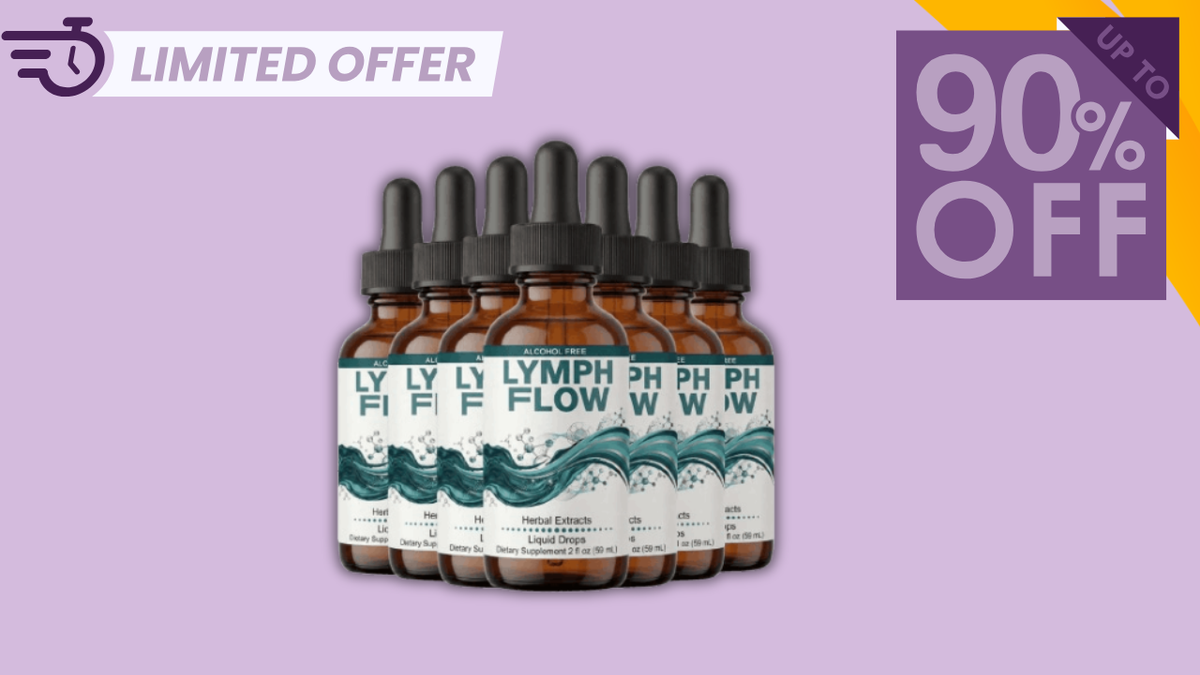
Lymph Flow is an alcohol-free liquid dietary supplement made with a proprietary blend of 13 botanical extracts and bio-active ingredients.
The official site says one serving equals two droppers, with 30 servings in each bottle. The serving can be mixed into water or juice once daily. Six highlighted botanicals are Boswellia Serrata, Curcumin, Horse Chestnut, Gotu Kola, Quercetin Phytosome, and Ginger Extract. The product contains soy.
The format has genuine appeal.
No large pills.
No powder explosion across the kitchen.
No complicated five-step schedule involving breakfast, the lunar cycle, and a special spoon.
Shake, measure, mix, drink.
That simplicity may help some people remain consistent.
The seller also says USA orders typically arrive within five to seven business days, with tracking sent by email after the order is processed. Shipping times are company estimates and may vary.
What does the available information not establish?
It does not establish guaranteed effectiveness for every customer.
It does not establish that ordinary puffiness always comes from slowed lymphatic function.
It does not convert seller testimonials into clinical evidence.
It does not make a proprietary blend completely dose-transparent.
Those limitations do not automatically destroy the product’s value.
They simply tell you where confidence should end.
Lymph Flow Complaints: Which Ones Deserve Attention?
Complaints are useful when they contain context.
“I hated it” tells you almost nothing.
“I used it daily for six weeks, noticed no benefit, contacted ClickBank on day 48, and received a refund within seven business days” tells you quite a lot.
Common reasonable concerns may include:
Price: Even the entry package costs $158 before its small shipping fee. That is a meaningful expense for many USA households.
Taste: Herbal liquid products can taste earthy, spicy, sweet, bitter—or like somebody rinsed a garden into a glass. Preferences vary.
Results: Some customers may experience no noticeable benefit. That is a valid personal outcome, even if others report satisfaction.
Proprietary blend: Buyers cannot easily compare every individual ingredient amount with published research.
Allergen and medication concerns: The product contains soy, and multi-ingredient botanical formulas deserve careful review when someone uses prescription medicine.
Marketing language: Claims about “transformation,” “regeneration phases,” or lasting results may sound stronger than the product-specific evidence publicly presented.
None of these concerns automatically prove fraud.
They are reasons to research properly.
Likewise, a customer saying “I love this product” is not automatically lying. They may genuinely enjoy it and recommend it.
Positive and negative experiences can both be real.
The world continues spinning despite this complexity.
Is Lymph Flow Reliable, 100% Legit, or a Scam?
Here is the blunt conclusion.
Lymph Flow appears to be a real commercial supplement.
It has an active official storefront, a published Supplement Facts section, package prices, usage directions, allergen information, USA manufacturing claims, customer-support details, shipping guidance, and a 60-day ClickBank refund process.
Those are meaningful legitimacy signals.
I found no evidence in the reviewed sources that justifies calling it an obvious scam.
But “100% legit” should not be used as shorthand for “guaranteed to produce every advertised benefit.”
A product can be legitimate while individual results vary.
A company can offer genuine customer service while its advertising sounds overly enthusiastic.
A formula can contain interesting ingredients without being appropriate for every person.
All three statements can be true at once.
My editorial position is favorable but grounded:
I like the alcohol-free liquid concept.
I like the clearly displayed serving information.
I like that soy is disclosed.
I like the written refund procedure.
I do not like unsupported certainty, invented review totals, fake personal experiences, or claims that ordinary puffiness proves a specific medical cause.
So yes—Lymph Flow looks reliable enough to consider through the official channel.
No—it should not be described as a guaranteed cure, instant fix, or universally successful formula.
That isn’t negativity.
It is the difference between recommendation and worship.
Stop Renting Your Judgment to the Loudest Review Page
The internet will keep producing extreme opinions.
Somebody will call Lymph Flow the greatest wellness breakthrough in modern USA history.
Somebody else will take one serving, feel nothing before lunch, and write “SCAM” using fourteen exclamation marks.
You cannot control either person.
You can control your standard of evidence.
Check where ratings originate.
Demand proof for exact review counts.
Separate customer stories from clinical evidence.
Read the ingredient label.
Investigate allergens and medication interactions.
Treat unexplained swelling seriously.
Compare the total package price—not merely the per-bottle discount.
Save your receipt and understand the refund period.
Then make the decision.
Not from panic.
Not from a countdown timer.
Not because a smiling stranger supposedly woke up “reborn” on day four.
Success in wellness rarely comes from one dramatic purchase. It usually comes from consistent movement, decent nutrition, appropriate hydration, sufficient sleep, medical care when needed, and carefully selected products that fit the individual.
Less exciting.
More effective.
Lymph Flow may deserve a place in that routine. Based on the information available, I consider it a legitimate product worth researching and potentially trying under the right circumstances.
But keep the bottle in perspective.
It is a supplement.
Your judgment remains the main ingredient.
Frequently Asked Questions
1. Is Lymph Flow a scam or a legitimate USA supplement?
Lymph Flow appears to be a legitimate commercial supplement with an active website, published pricing, a visible ingredient panel, customer-support information, and a 60-day ClickBank refund process.
That does not guarantee results for every customer.
Real bottle? Apparently yes.
Guaranteed miracle? No. Miracles rarely arrive with a tracking number and vegetable glycerin.
2. Does Lymph Flow really have a 4.91/5 rating?
The official seller website displays a 4.91/5 average rating and says the product is trusted by thousands of customers.
That figure should be described as an official website rating claim.
It should not be presented as an independently audited scientific score, and it does not support inventing a precise total such as “20,000 verified reviews” unless evidence for that number is available.
Numbers look serious.
Sometimes they are simply wearing good typography.
3. How quickly should Lymph Flow produce results?
The seller says many customers report noticing a difference within two to three weeks of consistent use, while other people may take longer.
That is not a guaranteed timetable.
Some customers may notice an effect sooner, later, or not at all. Individual health, routine, diet, activity, medications, and the underlying reason for puffiness can all complicate the experience.
Bodies are terrible at respecting marketing calendars.
4. Which Lymph Flow package is best for USA buyers?
The six-bottle package currently offers the lowest advertised price per bottle at $49 each, or $294 total. The three-bottle package costs $207, while the two-bottle package costs $158 plus a small shipping fee.
The six-bottle option is the best mathematical value.
A smaller package may be the better practical choice for a first-time buyer evaluating flavor, compatibility, routine, and personal response.
Your calculator can vote for six.
Your budget is allowed to vote differently.
5. Can Lymph Flow be taken with prescription medicine?
Do not assume that it can.
The FDA advises consumers to talk with a doctor, pharmacist, or other healthcare professional before using dietary supplements because supplements may carry risks or interact with medicines. Lymph Flow also contains soy, which matters for people with allergies or sensitivities.
Related Hastags
#LymphFlow #LymphFlowReview #LymphFlowReviews2026 #LymphFlowAppReview2026 #LymphFlowBonus #LymphFlowProduct #LymphFlowPrice #LymphFlowOffers #LymphFlowBonuses #LymphFlowBuy #LymphFlowWebsite #LymphFlowSite #LymphFlowApp #LymphFlowHonestReviews #LymphFlowLatestReviews #LymphFlowUsersExperience #LymphFlowUsersReview #LymphFlowDemo #LymphFlowTutorial #LymphFlowPurchaseOnline #LymphFlowBuyit