FoodStorageIQ Reviews and Complaints USA 2026: 5 Shocking Pantry Lies That Could Wreck Your 365-Day Survival Plan
⭐ Editorial Rating: 4.8/5 ⭐⭐⭐⭐⭐ — based on the disclosed features and intended usefulness, not a verified customer-rating average
📝 Verified Review Count: No independently confirmed total was provided on the sales page reviewed
💵 Claimed Original Price: $149 — not confirmed in the supplied FoodStorageIQ sales-page copy
💵 Usual Price: $67
💵 Current Deal: $67 one-time payment
⏰ Results Begin: Once household and food-inventory information is entered
📍 Made In: Not disclosed in the material reviewed
🇺🇸 Availability: Designed for preparedness-minded households, including buyers across the USA
🧘♀️ Core Focus: Turning stored food into an estimated number of survival days
✅ Who It’s For: Families, pantry organizers, preparedness beginners and people who are tired—seriously tired—of guessing
🎁 Included Extras: Four stated digital bonuses with a combined advertised value of $110
🔐 Refund: 60 days, according to the seller’s page
🟢 Our Say: Highly recommended as a food-storage planning tool. The supplied information gives us no reason to label FoodStorageIQ a scam. Still, “100% legit” should mean the product performs its disclosed function—not that it possesses magical powers, predicts the future or somehow puts groceries onto your shelves while you sleep.
Stop Believing Every Loud Person With a Basement Full of Beans
Food-storage misinformation has a particular smell.
Dusty cardboard. Warm plastic buckets. A faint whiff of panic.
You have probably seen the advice already. It appears in videos, social-media posts, neighborhood groups and dramatic articles written as though the entire USA will run out of groceries before next Thursday.
“Just buy more cans.”
“Copy this exact one-year list.”
“You don’t need calculations.”
“Calories are all that matters.”
“Once you buy an app, the job is finished.”
These statements are not always completely false. That is what makes them slippery.
A completely ridiculous lie is easy to reject. Nobody sensible believes a single jar of peanut butter will feed six adults for the winter. But misleading advice usually contains a small spoonful of truth, wrapped in confidence, dipped in urgency and served with five exclamation marks.
It sounds practical.
It feels comforting.
Then it quietly wrecks the plan.
The misinformation around FoodStorageIQ reviews and complaints in the USA works the same way. One camp may claim the product is an automatic survival solution. Another camp may dismiss it because “people stored food before computers existed.”
Yes, people also navigated before GPS existed. That does not make maps useless.
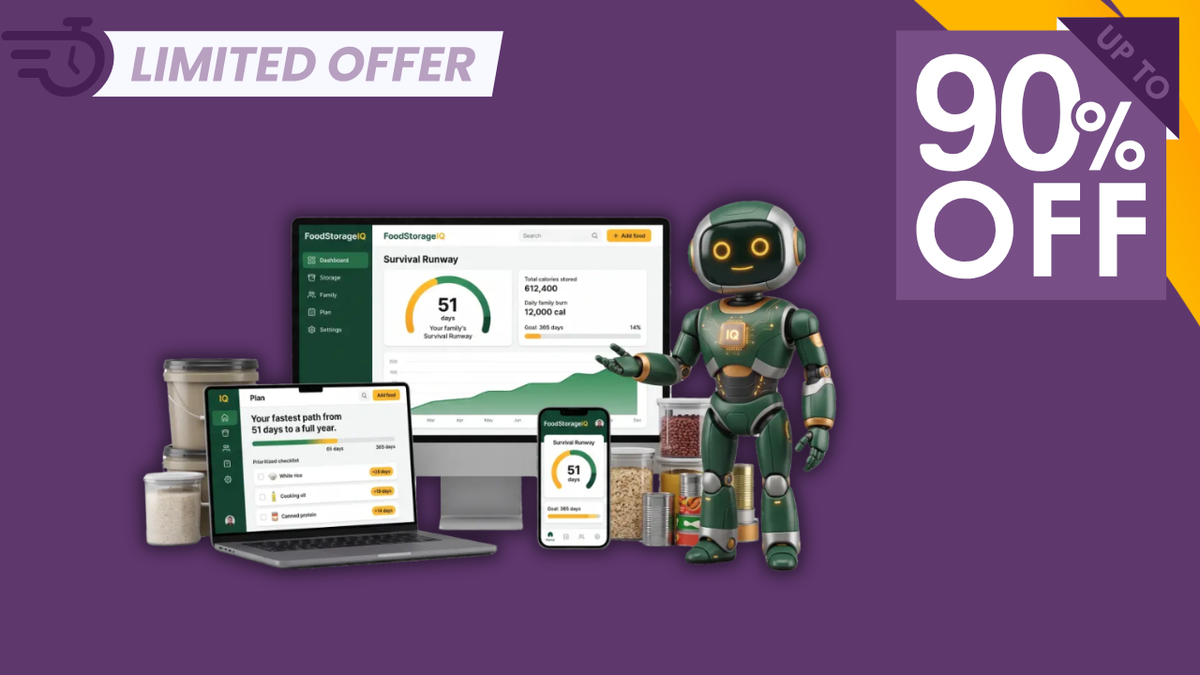
FoodStorageIQ’s central idea is fairly straightforward. Users enter details about the people in their household, record the food they have stored and receive an estimated Survival Runway—a calculation of how many days the available calories may support the household.
I like the concept.
It tackles a real, almost embarrassingly obvious problem: many people know how many products they own, yet cannot answer how long those products could last.
They have twelve cans of soup.
Great.
Is that twelve days of food? Twelve meals? Six meals for two people? A decorative metal wall?
Nobody knows until somebody does the arithmetic.
That gap between “we own food” and “we understand our food” is where bad advice grows like mold behind a refrigerator. Quietly. Then suddenly, everywhere.
Current USA preparedness guidance also takes a broader, more grounded approach than the panic merchants. Ready.gov says a household may need its own food, water and other supplies for several days after an emergency, and it recommends foods that do not depend heavily on refrigeration, cooking, water or special preparation. The site even reminds people to own a manual can opener—which sounds painfully obvious until you imagine staring at 70 sealed cans during a blackout.
So no, owning food is not enough.
Buying software is not enough either.
The useful approach sits somewhere in the middle: measure what you have, understand what it means, correct the weak spots and keep the information honest.
Now let’s tear apart five misleading beliefs that keep USA households stuck.
Some deserve a polite correction.
Others deserve to be chased down the street with a calculator.
Misleading Belief #1: “A Full Pantry Means You Have Months of Food”
This belief feels true because your eyes are easily impressed.
Open a packed pantry and the brain immediately relaxes. There are cans in tidy rows, jars shining under the ceiling light and cereal boxes standing shoulder to shoulder like badly trained soldiers.
It looks abundant.
The shelves groan a little. Very reassuring.
But a pantry is not measured by how dramatic it appears when the door opens. It is measured by how much usable food energy it contains—and how quickly the household consumes that energy.
Those are different things.
A family may own 100 cans of low-calorie vegetables, broth and light soup. Visually, that is a respectable wall of food. Photograph it from the correct angle and it could probably earn applause online.
Yet another household may have fewer containers containing rice, oats, pasta, beans, oil, nut butter and canned proteins. The second pantry may look smaller while providing substantially more calories.
Your stomach does not care how many labels are visible.
It does not award bonus points for color coordination either.
Why This Advice Is Flawed
The “full shelf equals long survival” idea confuses volume with duration.
Some packages contain a lot of empty space. Some canned products contain water and relatively few calories. Serving-size labels can create another illusion because “eight servings” sounds generous until you notice each serving is approximately three spoonfuls and a positive attitude.
Then household size enters the picture.
A pantry that might support one adult for several weeks will not last equally long for two adults, three active teenagers and a child. This should be obvious. Somehow it is not.
People keep mentally assigning a duration to their pantry without calculating the household’s daily demand. They say things like:
“We probably have four months.”
Probably based on what?
The angle of the shelving?
The emotional weight of the last Costco receipt?
This is not harmless guessing. It produces false confidence, which is considerably more dangerous than uncertainty.
Uncertainty says, “I should check.”
False confidence says, “Nothing else needs doing.”
What Happens When You Believe It
Imagine a USA household that assumes it owns six months of food.
Because the family feels covered, it stops adding staples. Nobody checks whether the stored meals are calorie-dense. Products get eaten without being replaced. A few packages are damaged by heat or moisture.
Then an extended disruption happens.
The shelves begin thinning much faster than expected.
Breakfast takes food.
Lunch, strangely enough, takes more.
Dinner arrives every evening like an invoice.
The family discovers that a large collection of products is not necessarily a long runway. Stress spikes. Portions shrink. Somebody starts defending the final jar of peanut butter with the intensity of a courtroom attorney.
The food did not fail.
The estimate never existed.
The Reality That Actually Works
Count calories, then compare them with realistic household needs.
That is where FoodStorageIQ can provide genuine value. Instead of judging the pantry by appearance, it converts inventory into an estimated duration.
The result is not divine revelation.
It depends on the information entered. If you forget half the household, inflate quantities or include food that was eaten six months ago, the displayed number may be wonderfully precise and completely useless.
Garbage in, runway fiction out.
Enter every item honestly. Include only food that is physically available and usable. Update the record when something is consumed, purchased or discarded.
Then add a safety margin.
A displayed estimate of 90 days should not be treated as 90 indestructible days sealed inside a vault. Food gets wasted. Appetite shifts. Guests arrive. Stress can change eating patterns. Children become mysteriously hungry immediately after claiming they did not want dinner.
Use the number as a planning instrument.
Not a promise tattooed by the universe.
Misleading Belief #2: “A Stranger’s One-Year Food List Will Work for Every USA Family”
The internet adores universal shopping lists.
They are neat.
They eliminate thinking.
They arrive with titles such as:
“THE ONLY 30 FOODS YOU NEED FOR ONE YEAR.”
Really?
Every person in the USA?
Every age, climate, household size and medical situation?
That is not a shopping list. That is confidence performing gymnastics.
Generic lists can be helpful starting points. Rice, beans, oats, canned proteins and other shelf-stable products appear frequently for sensible reasons.
The trouble begins when a person copies somebody else’s list without adapting it.
A couple in Arizona does not have identical needs to a six-person household in Maine. A family preparing for hurricane-related outages in Florida may prioritize foods requiring little water or cooking. A family facing winter storms in North Dakota may think differently about temperature, heat and fuel.
Then there are allergies, medical diets, infants, elderly relatives, pets and personal preferences.
Yes, preferences still matter.
Some preparedness personalities act as though a hungry child will cheerfully eat anything placed in front of them. Perhaps. Or perhaps you are now managing a stressful emergency and a seven-year-old conducting a hunger strike against canned lima beans.
Fantastic.
Exactly the calm atmosphere everyone wanted.
Why This Advice Is Flawed
A universal list ignores the household’s actual consumption pattern.
FoodStorageIQ reportedly estimates needs using factors such as age, sex and activity. That is more rational than pretending every person burns the same number of calories.
But calorie demand is only one part of personalization.
Can the family eat the food safely?
Can it prepare the food without normal utilities?
Will the products be rotated through ordinary meals?
Does the plan contain familiar meals or merely disconnected ingredients?
A storage room containing 200 pounds of dry beans may look formidable. Beans are affordable and nutritious. They also require water, preparation time and cooking fuel.
During a power outage with limited water, that matters.
Potential food is not always immediate food.
A brick is potentially part of a house. You cannot sleep comfortably under one brick.
The Consequences of Copying Blindly
People waste money buying products they do not use.
The food sits.
Time passes.
Boxes soften. Labels fade. The smell of old flour and warm cardboard settles over the shelf. Nobody wants to admit the purchase was a mistake, so the products remain there like an expensive family secret.
Eventually they are discarded.
Then the buyer complains that food storage “doesn’t work.”
No, the copied plan did not fit.
That distinction is important.
Another risk is nutritional monotony. A person may assemble a large calorie total from a narrow collection of ingredients while ignoring variety, normal meal patterns and individual dietary needs.
FoodStorageIQ itself states that its figures are planning estimates, not medical or nutritional advice. Good. That disclaimer is not boring legal confetti—it identifies the boundary of the product.
The Reality That Actually Works
Start with the people who will eat the food.
List household members and think through:
- Daily energy needs
- Dietary restrictions
- Allergies
- Foods they normally consume
- Preparation requirements
- Water requirements
- Cooking-fuel needs
- Infant or senior needs
- Pet supplies
- Products that can be eaten without heating
Ready.gov’s updated planning guidance tells households to customize emergency plans and supplies around their specific daily needs and responsibilities, rather than relying on a universal template.
That is the opposite of blindly copying an influencer’s bunker tour.
Use FoodStorageIQ to establish a personalized calorie framework, then apply ordinary human judgment.
Build actual meals, not just piles.
Twenty jars of pasta sauce without enough pasta is not preparedness. It is an oddly specific liquid collection.
Misleading Belief #3: “Food Storage Is a One-Time Purchase”
This lie is extremely attractive.
Spend one exhausting Saturday shopping.
Stack everything beautifully.
Close the door.
Prepared forever.
Done.
The receipt may be long enough to use as a scarf, and your bank account may now sound like a distant ambulance—but the job is finished.
Except it isn’t.
Food storage moves.
People eat the products. Packaging gets dented. Moisture slips into basements. Heat damages quality. Pests investigate, because pests have never respected personal boundaries.
Households change too.
Children grow and eat more. Someone develops a dietary restriction. A relative joins the household. People move. Preferences shift.
The carefully calculated pantry from three years ago may now describe a family that no longer exists.
Why This Advice Is Flawed
It treats stored food like furniture.
Buy it once, place it somewhere and assume it remains available indefinitely.
But food has dates, packaging requirements and storage limitations. Even long-lasting products need inspection.
Inventory records also become inaccurate surprisingly fast.
Someone takes two cans for dinner.
Another family member grabs snacks.
A bag tears.
An item gets donated.
Nobody updates the application because “we’ll do it later.”
Later is a foggy nation where all unfinished chores apparently live.
Six months afterward, the digital inventory says 140 items while the shelf contains 103 and one unidentifiable can with half a label.
FoodStorageIQ can only calculate from the data it receives. It cannot hear a jar being removed from the pantry. It cannot detect your midnight peanut-butter decisions through the walls.
Probably for the best.
The Consequences of Neglect
First, the Survival Runway becomes inflated.
The number may look reassuring, but it includes products that no longer exist. You are measuring fictional calories.
Second, poor rotation wastes money.
Families often buy specialty emergency foods they never incorporate into ordinary meals. Years later, they discover damaged packaging, degraded quality or products nobody remembers wanting.
The resulting smell can be unforgettable. Stale grain, damp paper, a touch of regret.
Third, food-safety mistakes can make people sick.
CDC guidance updated in November 2025 warns that food can become unsafe following power outages, floods and other emergencies, and recommends throwing food away when its safety is uncertain rather than tasting it to investigate.
“Taste it and see” is not a safety protocol.
It is a dare.
The Reality That Actually Works
Rotate continuously.
Use the oldest suitable items first. Replace what gets consumed. Check packages for damage, moisture, corrosion, swelling, leakage and pest activity.
Update FoodStorageIQ when the change occurs.
Not next weekend.
Do it while the product is in your hand, because later you will be distracted by a phone call, a barking dog or some baffling household crisis involving a missing shoe.
A simple routine works better than dramatic annual cleanouts:
- Brief monthly inventory check
- Deeper inspection every six months
- Immediate updates after adding or using food
- Regular preparation of meals from stored supplies
- Printed backup inventory kept somewhere accessible
FoodStorageIQ includes a stated bonus called the Shelf-Life & Rotation Bible, plus a printable Blackout Binder. Those extras match the practical need: food should move through a system, and essential information should not vanish when a phone or internet connection is unavailable.
The point is maintenance.
Boring? A little.
Effective? Very.
Most reliable systems are less exciting than the advertisements selling them.
Misleading Belief #4: “The Exact Runway Date Is a Guaranteed Prediction”
FoodStorageIQ’s phrase “the exact day your food runs out” is memorable.
It lands.
People like precision because it feels authoritative. “Approximately two months” sounds uncertain. “October 17” sounds as though a laboratory issued a certificate.
But mathematical precision and real-world certainty are not the same thing.
Suppose a pantry contains 300,000 recorded calories. Suppose the household is estimated to consume 6,000 calories per day.
The calculation gives 50 days.
The arithmetic is clean.
Reality is muddy.
Did every item get recorded accurately?
Will every calorie be eaten rather than spilled or wasted?
Will household activity remain stable?
Will another person need to share the food?
Will every product be accessible and safe?
What if the family uses more fuel and calories during cold weather? What if somebody becomes ill? What if a glass jar hits the kitchen floor and sends sticky peaches skidding under the refrigerator?
There goes part of day 42.
Why This Advice Is Flawed
People confuse a specific number with a guaranteed outcome.
The displayed runway is based on assumptions. Change the assumptions and the result changes.
This is not a criticism unique to FoodStorageIQ. Every planning model works through inputs and assumptions.
A household budget estimates future expenses. A weather forecast estimates conditions. A navigation app estimates arrival time—then traffic appears and suddenly you are staring at brake lights, wondering whether society has collapsed on the interstate.
Models guide.
They do not command reality.
The Consequences of Blind Trust
A family may stop building supplies because the dashboard shows a comfortable number.
It may also forget that calories are only one component of emergency readiness.
What about water?
What about cooking?
What about medication, hygiene, communication and evacuation?
Ready.gov’s current kit guidance says households should prepare food, water and other basic supplies for several days. Its separate water guidance warns that normal drinking-water sources can be cut off or contaminated after a disaster.
A 365-day calorie estimate paired with very little safe water is not a one-year survival system.
It is an impressive spreadsheet standing next to a serious problem.
The runway number may also create disappointment when actual consumption differs. A user could conclude that the product was unreliable, when the issue was inaccurate inventory or changing household behavior.
That does not mean every complaint is automatically invalid. Software could have limitations. A database may omit certain products. The interface may not suit every user.
But expecting an estimate to behave like fate is unreasonable.
The Reality That Actually Works
Treat the runway as a living planning estimate.
Test it.
Record one or two weeks of normal food consumption. Compare what the household actually used with the projected daily rate.
Review the household profile when circumstances change.
Build a buffer rather than planning to arrive at zero with cinematic timing.
If your goal is 90 days, consider storing more than the mathematical minimum. This allows room for waste, guests, measurement error and changing demand.
Then create separate plans for water, food preparation, sanitation, medication, lighting, communication and local hazards.
The 2026 Ready.gov Preparedness Calendar encourages people to adapt activities to hazards affecting their own area, including events such as floods, hurricanes, wildfires and extreme heat.
Local reality matters.
A beautiful national checklist cannot see the river behind your house.
Misleading Belief #5: “Buying FoodStorageIQ Means the Work Is Finished”
This belief is the digital version of purchasing running shoes and expecting your cardiovascular fitness to improve while the shoes remain in the box.
You bought the tool.
You created the account.
You entered several cans.
The dashboard appeared.
A small wave of accomplishment passed through the room.
Prepared.
No.
Organized, perhaps.
Informed, hopefully.
Finished? Not even close.
FoodStorageIQ cannot physically add food to the pantry. It cannot force you to replace used items. It cannot test your backup stove, refill fuel or persuade a stubborn family member to eat powdered eggs.
Some problems remain beyond software.
Why This Advice Is Flawed
Information feels like action.
The brain often rewards us for planning as though the task itself was completed. We make the list and feel productive. We download the app and feel transformed.
Then nothing changes.
A person may discover that their household has only 21 estimated days of food. That is valuable information.
It is also uncomfortable.
Instead of taking small steps, some people see the enormous gap between 21 days and a one-year goal and freeze. The target feels expensive and impossible.
So they avoid the dashboard.
Eventually the login joins a graveyard of forgotten passwords.
This is where the tool gets blamed for the user’s all-or-nothing thinking.
The Consequences of Waiting for Perfection
No progress happens.
The family may believe that unless it can build a 365-day supply immediately, smaller improvements are meaningless.
That is absurd.
Adding five reliable days improves the position.
Replacing damaged supplies improves the position.
Learning to prepare one meal without electricity improves the position.
Preparedness is cumulative. It is built in dull little increments while normal life continues to make noise around you.
Current Ready.gov low-cost guidance recommends building a kit gradually and picking up an extra regularly used item during grocery trips, particularly when it is on sale.
There is no explosion in that advice.
No dramatic countdown.
Just steady behavior.
That is probably why it works.
The Reality That Actually Works
Turn the runway into a series of manageable actions.
Instead of declaring, “I need a full year immediately,” set a smaller objective:
Add three days this month.
Buy one extra shelf-stable staple during each normal grocery trip.
Replace five items nearing their rotation point.
Cook one stored-food meal without relying on electricity.
Print a fresh inventory.
Then repeat.
FoodStorageIQ includes a stated Year-in-a-Box Shopping List, described as prioritizing affordable, calorie-dense foods. That may help users decide what to buy first, but it should be adapted to the household’s budget and eating habits.
Do not build an enormous food reserve by ignoring rent, insurance, medical expenses or debt.
Creating a financial emergency in order to prepare for a hypothetical emergency is an odd strategy.
A very American strategy, perhaps—but odd.
Progress should feel sustainable.
Almost boring.
Boring keeps showing up because boring does not depend on adrenaline.
FoodStorageIQ Reviews and Complaints USA: What Is Actually Verified?
Here is where many review articles become slippery.
They announce:
“Over 20,000 reviews!”
“Perfect five-star rating!”
“Zero complaints!”
Then they provide no source.
A large number printed beside five yellow stars is not evidence. It is decoration with ambition.
The FoodStorageIQ sales-page content supplied for this review does not provide an independently verified customer-review count or a representative complaint database.
Therefore, this article will not invent one.
The 4.8/5 rating at the beginning is an editorial assessment based on the disclosed concept, price, bonuses and likely usefulness. It is not presented as the average of thousands of customers.
Likewise, no supplied evidence justifies claiming that FoodStorageIQ has widespread complaints.
Potential concerns are easier to identify:
- Inventory entry may require time.
- Records must be updated regularly.
- Users may expect more automation than is offered.
- Some uncommon products may require manual entry.
- Estimates can differ from actual consumption.
- Buyers may misunderstand what the runway number represents.
These are plausible limitations.
They are not proven mass complaints.
That distinction matters, even if it is less exciting.
As for the word “scam,” nothing in the provided sales copy suggests an incoherent or impossible product. The basic mechanism—comparing household calorie demand with stored-food calories—is reasonable.
The page identifies the $67 one-time price, lifetime access, four bonuses, a 60-day refund policy and ClickBank as retailer. It also includes a results disclaimer stating that figures and timelines are estimates.
That is what is known from the provided material.
It does not prove that every customer will love the interface.
It does not prove flawless customer service.
It does not prove that every calculation will perfectly mirror reality.
But it supports the conclusion that FoodStorageIQ presents a legitimate planning concept rather than an impossible promise.
Reliable within its intended role?
Potentially, yes.
A magic survival machine?
Please.
Highly Recommended—But Only for People Willing to Tell the Truth About Their Pantry
FoodStorageIQ solves a problem most households underestimate.
Guessing.
People look at shelves and invent timeframes. They count cans instead of calories. They buy products without considering preparation. They forget rotation. Then they call the resulting confusion “preparedness.”
FoodStorageIQ offers a cleaner approach:
Record the household.
Record the food.
Calculate an estimated runway.
See the gap.
Improve it.
That sequence is useful.
The product seems especially suitable for USA families that already own stored food but lack a clear inventory, beginners who dislike complicated spreadsheets and people motivated by measurable goals.
The $67 one-time price may be reasonable for lifetime access, provided the software fits the buyer’s workflow. The stated 60-day refund period gives users a chance to evaluate that fit.
Still, the tool cannot compensate for dishonesty or neglect.
If you enter inaccurate quantities, ignore consumed products and treat the result as prophecy, the number will mislead you.
Not because numbers are evil.
Because you fed them a fairy tale.
Reject the misinformation.
A crowded pantry is not automatically a long runway. A stranger’s food list is not your family’s plan. Storage is not a one-time purchase. A calculated date is not destiny. And buying software does not finish the physical work.
Measure honestly.
Customize intelligently.
Rotate consistently.
Improve gradually.
The loudest advice in the USA preparedness world is often the least useful. It screams because it needs attention.
A reliable system does not need to scream.
It sits quietly on the shelf, updated and understood, waiting to do its job.
That is not glamorous.
It is better than glamorous.
It works.
Frequently Asked Questions
1. Is FoodStorageIQ legit or a scam in the USA?
Based on the supplied sales-page information, FoodStorageIQ presents a technically plausible planning tool. It estimates how long stored food may last by comparing available calories with a household’s estimated daily needs.
Nothing in the supplied material supports calling it a scam.
However, “100% legit” should not be interpreted as a government certification, a guarantee of survival or proof that every customer will receive identical results.
It is an estimation and organization tool.
Not a wizard in a laptop.
2. Does FoodStorageIQ really have a 5/5 customer rating?
No independently verified customer-rating average was included in the material reviewed.
The rating at the beginning of this article is clearly labeled as an editorial score. It reflects our assessment of the disclosed concept and offer—not a claimed average from 20,000 customers.
Any page claiming a huge review count should identify the source.
Otherwise the number is just wearing makeup.
3. What does FoodStorageIQ cost?
The supplied sales page lists FoodStorageIQ at $67 as a one-time payment with lifetime access.
It also advertises four bonuses with a stated combined value of $110 and a 60-day money-back guarantee.
The page supplied did not confirm a regular $149 price, so that amount should not be presented as verified.
Always examine the final checkout terms before paying. The large headline wants your attention; the smaller text wants your responsibility.
4. What are the likely FoodStorageIQ complaints?
No representative customer-complaint database was provided, so claiming specific widespread complaints would be misleading.
Possible areas of concern include manual inventory entry, the need for regular updates, differences between estimated and actual consumption, database coverage and users expecting complete automation.
Those are potential limitations—not verified accusations.
A complaint should come from a real customer.
Not from a writer needing another dramatic subheading.
5. Who should use FoodStorageIQ?
FoodStorageIQ may be a strong choice for USA households that own food supplies but cannot confidently answer, “How long will this actually last?”
It may also help preparedness beginners, visual planners and people who want a simpler alternative to building a detailed calorie spreadsheet.
Related Hastags
#FoodStorageIQ #FoodStorageIQReview #FoodStorageIQReviews2026 #FoodStorageIQAppReview2026 #FoodStorageIQBonus #FoodStorageIQProduct #FoodStorageIQPrice #FoodStorageIQOffers #FoodStorageIQBonuses #FoodStorageIQBuy #FoodStorageIQWebsite #FoodStorageIQSite #FoodStorageIQApp #FoodStorageIQHonestReviews #FoodStorageIQLatestReviews #FoodStorageIQUsersExperience #FoodStorageIQUsersReview #FoodStorageIQDemo #FoodStorageIQTutorial #FoodStorageIQPurchaseOnline #FoodStorageIQBuyit