5 Overhyped Myths About Emergency Pantry Meals System Reviews and Complaints 2026 USA — The Truth Most Buyers Won’t Hear Until After Checkout
⭐ Ratings: 4.8/5 ⭐⭐⭐⭐⭐
📝 Reviews: Early buyer-style feedback looks positive, and USA search interest is growing
💵 Original Price: $97
💵 Usual Price: $37
💵 Current Deal: $37 one-time digital access
⏰ Results Begin: Once you start organizing your pantry and using the planning pages
📍 Made For: USA households, families, couples, beginners, and busy homes
🧘♀️ Core Focus: Shelf-stable meals, emergency pantry planning, food rotation, restock, and simple household readiness
✅ Who It’s For: USA families who want practical preparation without the doomsday noise
🔐 Refund: 60 Days. No questions asked.
🟢 Our Say? Highly recommended for the right buyer. No obvious scam signs. Reliable, practical, and 100% legit as a digital pantry planning guide.
Let’s not pretend the internet is calm.
You search Emergency Pantry Meals System Reviews and Complaints 2026 USA, and suddenly every page wants your attention like a guy waving a giant sign outside a clearance store.
One review says it is “100% legit.”
Another says, “Don’t buy before reading this.”
Someone else throws in “scam or real?” because, honestly, that keyword gets clicks.
And then there are those soft, fluffy reviews that say everything is amazing but somehow explain almost nothing.
That bothers me.
Not because Emergency Pantry Meals System looks bad. Actually, from the sales page details, I like the idea of it. A simple digital guide that helps USA households organize shelf-stable foods, plan emergency pantry meals, rotate items, and build 7-day, 14-day, and 30-day pantry layers? That is useful.
Very useful, if you actually use it.
But the problem is the hype around products like this gets messy. People either treat it like a miracle pantry solution or dismiss it because it is “just digital.” Both reactions are a bit lazy. Sorry, but they are.
Emergency Pantry Meals System is not a magic button.
It is not a box of food.
It is not a government emergency plan.
It is not going to sneak into your kitchen at midnight and label your canned beans.
But it can help you build a calmer and more organized pantry system using normal grocery-store foods. And in the USA, where grocery bills feel heavier, weather disruptions are more common in different regions, and busy families are already stretched thin, that kind of simple structure can be a big deal.
I remember one winter evening — not dramatic, just annoying — when the power flickered, the fridge hummed like it was giving up on life, and I opened the pantry thinking, “Okay, we have food.” But then came the real question.
What food?
There was pasta. Some soup. A lonely can of corn. Peanut butter. Crackers that may or may not have been fresh. And that weird moment hit: having food is not the same as having meals.
That is the crack where panic slips in.
And that is why these myths matter.
Because bad reviews mislead people. Overhyped reviews mislead people too. A grounded review helps people decide properly. Not with fear. Not with shiny sales language. Just the truth, with a little kitchen-table common sense.
So let’s break down the biggest myths around Emergency Pantry Meals System Reviews and Complaints 2026 USA, and let’s do it in a way that actually helps someone before they buy.
Myth #1: “Emergency Pantry Meals System Is Just a Basic Checklist You Can Find Free Online”
This myth sounds smart at first.
People say, “Why pay $37 when I can find emergency food checklists online for free?”
Fair question.
But it is also incomplete.
Yes, you can find free checklists. USA emergency websites and preparedness pages often tell people to store non-perishable food, water, flashlights, batteries, medicine, and basic supplies. That advice is good. Nobody should ignore it.
But a checklist is not the same as a working pantry system.
That is where people get confused.
A checklist says:
Buy non-perishable food.
Okay. Great.
But then what?
What meals can you make from it?
How many days can it cover?
What can you eat if the power is out?
What should be rotated first?
What does a 7-day pantry actually look like for your family?
How do you build up to 14 or 30 days without wasting money?
What if your kids refuse half the food?
What if you bought beans but forgot a can opener?
That last one sounds silly until it happens.
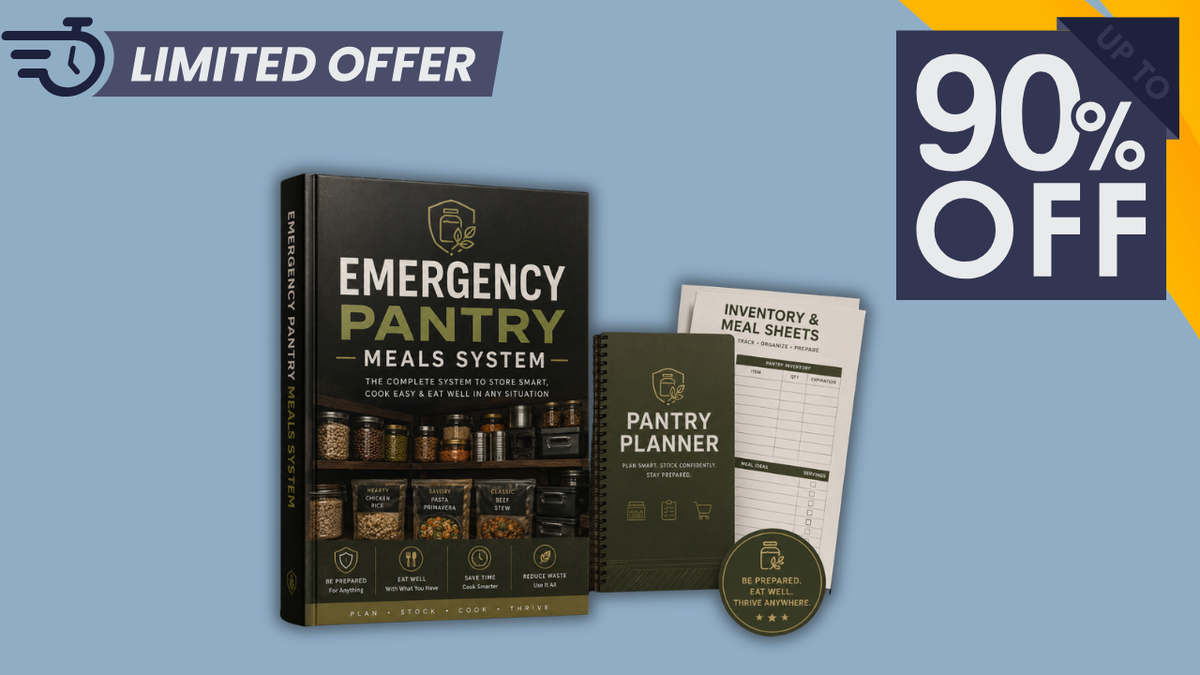
This is why Emergency Pantry Meals System is more useful than a plain checklist. It is built around structure. According to the sales page, it includes 180+ shelf-stable meal ideas, 7-day, 14-day, and 30-day pantry planning frameworks, rotation guidance, restock notes, storage references, worksheets, charts, and quick-use pages.
That is not just “buy canned food.”
That is more like, “Here is how to make your pantry less chaotic and more usable.”
And there is a difference. A big one.
A USA family in Florida preparing for hurricane season does not need random cans sitting on a shelf like tiny metal decorations. They need meals. A family in Michigan dealing with winter storms needs no-cook or low-cook options. A busy couple in California may just want backup meals for wildfire-related disruptions or sudden grocery delays.
Different household. Same principle.
Food without a plan is just storage.
Food with a plan becomes security. Not perfect security, but something. A little breathing room.
That is why this “free checklist” myth is misleading. It assumes information is the same as implementation. It is not.
You can read ten free articles and still have a pantry that looks like a raccoon packed it during a thunderstorm.
Emergency Pantry Meals System may not be revolutionary in a loud, fireworks way. But it takes scattered ideas and puts them into a cleaner household framework. And for many USA buyers, that is the value.
The truth?
Emergency Pantry Meals System should not be judged as “just another checklist.” It should be judged as a practical digital planning system for people who want meal ideas, structure, rotation, and a step-by-step pantry build path.
That is a much fairer way to look at it.
Myth #2: “If It’s a Digital Product, It Must Be Low Value or a Scam”
This one is everywhere.
The second people hear “digital guide,” they get suspicious.
No box?
No printed book?
No food delivery?
No jars, bags, containers, or survival buckets?
Then someone whispers, “Scam.”
But slow down.
Digital does not automatically mean scam. That is like saying an email is fake because it is not printed on paper. Come on.
Digital products can be extremely useful when they solve a real problem. Meal plans, budgeting templates, online courses, training manuals, fitness guides, tax resources, recipe books — all digital. Some are excellent. Some are trash. The format alone does not decide the value.
What matters is clarity.
And from the sales page details, Emergency Pantry Meals System is clear about what it is:
It is a digital product.
No physical product will be shipped.
It costs $37.
There is no subscription.
It offers instant digital access.
It includes a 60-day money-back guarantee.
That is actually pretty transparent.
Most complaints around digital products happen when buyers misunderstand the offer. Someone expects emergency food packets in the mail. Someone thinks they are buying a printed manual. Someone assumes the product is a full emergency survival course. Then they feel disappointed.
But disappointment from wrong expectations is not always proof of a scam.
It is proof that people did not read carefully — or that some reviews did not explain the offer honestly enough.
A proper Emergency Pantry Meals System review should say this clearly:
You are buying a digital pantry planning guide.
You are not buying food.
You are not buying physical supplies.
You are not buying a government-approved emergency plan.
You are buying organization, meal ideas, charts, planning pages, and pantry guidance.
That makes the product easier to judge.
And honestly, digital access can be a plus.
If you are in the USA and want to start preparing before storm season, winter weather, or a possible local power outage, waiting for shipping is not ideal. A digital guide can be opened quickly. You can print the useful pages. Put them in a binder. Tape a rotation chart inside your pantry. Use the meal ideas while making your grocery list.
Very glamorous? No.
Very usable? Yes.
I like boring things that work. A sturdy shelf. A sharp pencil. A printed checklist with coffee stains on it. Not everything needs to sparkle.
The myth that digital means low value is lazy.
The real question is: does the digital guide help you take action?
With Emergency Pantry Meals System, the answer seems yes, if you use it properly.
The truth?
Emergency Pantry Meals System does not look like a scam just because it is digital. It appears to be a legit digital guide with clear pricing, clear delivery terms, and a refund policy. The value depends on whether the buyer wants a practical planning system rather than a physical emergency food kit.
Myth #3: “Buying Emergency Pantry Meals System Means You’re Fully Prepared for Any Emergency”
Now let’s talk about overhype from the positive side.
Some reviews make products sound like they solve everything.
Buy this guide and your pantry is fixed.
Buy this guide and your family is ready.
Buy this guide and every emergency becomes manageable.
No.
That is too much.
Emergency Pantry Meals System is useful, but it is not a full emergency preparedness solution for every situation. And that is okay. It does not need to be.
The product itself includes a disclaimer that it is for general educational and informational purposes only. It is not medical advice, emergency-response advice, food safety advice, or a guarantee of preparedness for any specific event.
That matters.
A pantry guide can help with one important part of readiness: food planning.
But real household preparedness may also include water, medication, first aid, communication, evacuation planning, power backup, sanitation, pet supplies, official alerts, documents, and local safety guidance.
No single $37 guide should be expected to replace all that.
This myth persists because people want one purchase to remove uncertainty.
And I get it. Uncertainty feels awful. It sits in the chest like a stone. Especially for parents. You look at your kids, your house, your half-organized pantry, and you think, “Am I doing enough?”
So when a product offers structure, people may emotionally inflate what it can do.
But grounded thinking is better.
Emergency Pantry Meals System can help you organize shelf-stable foods. It can help you plan no-cook, low-cook, and one-pot meals. It can help you think in 7-day, 14-day, and 30-day layers. It can reduce that blank-brain feeling when you open the pantry and do not know what to make.
That is valuable.
But it is not everything.
Think of it like a map. A map helps you travel, but it does not fill your gas tank, fix your tires, or stop the rain. Still useful, though.
For USA households, the best approach is to use Emergency Pantry Meals System as the pantry and meal-planning section of a larger home readiness plan.
Use it for food organization.
Then use official emergency guidance for water, alerts, safety, and local risk planning.
That is the smart way.
Not blind trust. Not angry dismissal. Just a realistic role for the product.
The truth?
Emergency Pantry Meals System is not a guarantee of full preparedness. It is a practical guide that can strengthen your pantry meal planning. If USA buyers understand that, they are much less likely to feel misled and much more likely to get real results from it.
Myth #4: “Emergency Pantry Planning Is Only for Hardcore Doomsday Preppers”
This myth annoys me.
A lot.
Because it keeps normal households unprepared.
Some people hear “emergency pantry” and instantly picture a basement stacked with food buckets, weird survival gadgets, and someone yelling into a camera about the end of everything.
That image is loud. It is also not what practical pantry planning has to be.
Emergency pantry planning can be normal. Quiet. Almost boring.
And boring is good when the power goes out.
Most USA families already do small preparedness things without calling it that. They buy extra toilet paper. Keep pain relievers in the cabinet. Charge phones before storms. Store batteries. Keep snacks for road trips. Fill the car with gas before bad weather.
Pantry planning is the same idea.
It is not panic.
It is margin.
Margin means you are not one closed grocery store away from stress. Margin means you can make a meal if the week becomes chaotic. Margin means a short-term disruption does not instantly turn into “everyone get in the car, we need supplies.”
That is a good feeling.
Emergency Pantry Meals System positions itself as practical preparedness, not extreme doomsday stockpiling. That is important. It uses normal grocery-store foods, simple meal ideas, pantry categories, and planning frameworks.
That makes it easier for real USA households.
A family in Louisiana may want hurricane-season pantry meals. A household in Colorado may think about winter storms. A California family might care about wildfire disruption planning. A New York apartment dweller may just want a compact backup pantry because space is tight and grocery delivery is not always reliable.
None of that is extreme.
It is just being sensible.
Like keeping an umbrella in your car. Nobody calls you a storm conspiracy theorist for that.
The myth survives because preparedness marketing has been too dramatic for too long. Too much fear. Too much shouting. Too much “buy now before it’s too late.”
But Emergency Pantry Meals System works better when seen as a calm household tool.
Not fear.
Not fantasy.
Just food, meals, rotation, and a plan.
That is why I think it is reliable for the right buyer. Not because it makes wild promises, but because it solves a boring problem that actually matters.
The truth?
Emergency pantry planning is not only for preppers. It is for USA families, beginners, couples, busy parents, seniors, and anyone who wants a more organized food backup plan. Emergency Pantry Meals System fits that practical lane well.
Myth #5: “The 180+ Meal Ideas Automatically Fix Your Pantry”
This is the sneakiest myth because it uses a real benefit.
Emergency Pantry Meals System includes 180+ emergency meal ideas. That sounds excellent. And it is a strong feature.
But let’s be honest.
A big list does not automatically create results.
A list is a list.
A list does not buy groceries. It does not check expiration dates. It does not know your child hates tuna. It does not know your spouse gets weirdly emotional about canned peas. It does not know your pantry shelf is tiny or your stove may not work during an outage.
Meal ideas are helpful only when you turn them into a household plan.
This is where many reviews overhype the product. They say “180+ meal ideas” like that alone solves the problem.
It does not.
The better way to use those meal ideas is to narrow them down.
Start with meals your household already eats.
Then add easy backups.
Then add no-cook options.
Then add comfort foods.
Then build your first 7-day plan.
Do not try to use all 180 ideas. That is madness. That is like opening a streaming app with 5,000 movies and still watching nothing.
Too many options can freeze people.
A USA family should use the meal library as a menu, not a mountain.
Pick maybe:
7 breakfasts
7 lunches
7 dinners
10 snack or comfort options
5 no-cook backups
5 low-cook meals
A few one-pot meals
That is already a strong start.
Then rotate. Restock. Adjust.
This is the unsexy part that makes the system work.
If your household eats oatmeal, pasta, soup, canned beans, peanut butter, crackers, rice pouches, shelf-stable milk, tuna, canned fruit, and instant potatoes, then build around those foods first.
Not around fantasy foods.
Not around foods you think prepared people should eat.
Around what your people actually eat.
Because in a stressful moment, familiar food matters. A warm bowl of soup can feel weirdly emotional. Crackers and peanut butter can feel like survival royalty when everyone is tired and the lights are flickering.
The guide gives options. You create the real plan.
That is the truth most hype reviews skip.
The truth?
The 180+ meal ideas are a powerful feature, but they do not automatically fix your pantry. USA buyers get the best results when they customize the ideas into a simple 7-day, 14-day, or 30-day plan based on real household preferences, storage space, budget, and cooking conditions.
What Emergency Pantry Meals System Reviews and Complaints 2026 USA Should Actually Tell You
A good review should not just scream “scam” or “100% legit.”
That is too thin.
A real review should explain what the product is, what it is not, who should buy it, and who should avoid it.
So here is the clearer version.
Emergency Pantry Meals System is a digital guide for pantry planning.
It includes meal ideas, planning frameworks, rotation help, storage notes, restock guidance, worksheets, and quick reference pages.
It is priced at $37.
It has a 60-day money-back guarantee.
It is not a physical product.
It does not ship food.
It is not a replacement for official emergency management, medical, or food safety advice.
That is the clean truth.
And based on the provided details, there are no obvious scam signs. The offer is clear about digital delivery, pricing, refund policy, and product purpose.
So why might complaints happen?
Usually because of mismatched expectations.
Someone thinks they are buying emergency food.
Someone expects a printed book.
Someone wants personalized meal plans.
Someone wants advanced survival training.
Someone buys the guide and never uses it.
Someone does not read the digital-only notice.
That does not make the product bad.
It means buyers need to understand the offer properly.
And marketers need to stop being vague.
If you are promoting this product, say the truth strongly. It is better.
The truth sells better than fog.
Is Emergency Pantry Meals System Worth It for USA Buyers?
For many USA households, yes.
Especially if your pantry is full but your plan is empty.
That is the real audience.
People who already have random food but no system. People who want to prepare without getting overwhelmed. People who want normal grocery-store foods instead of expensive survival kits. People who want simple meal ideas, not fear-based noise.
Emergency Pantry Meals System is worth considering if you want:
A practical pantry structure
Shelf-stable meal ideas
No-cook and low-cook options
7-day, 14-day, and 30-day planning
Food rotation guidance
Restock notes
Printable planning pages
A beginner-friendly approach
A calmer way to prepare
It may not be worth it if you want:
Physical food delivered
A printed book in the mail
Advanced survival training
Personalized nutrition planning
Official emergency-response guidance
A product that does all the work for you
That last one is important.
No guide works if you do not use it.
You have to open it. Print the pages. Choose the meals. Check the pantry. Label the food. Rotate items. Build the plan.
Yes, that sounds like work.
But not terrible work.
More like one afternoon of slightly annoying organization that later saves you from a lot of stress.
Put on music. Make coffee. Pull everything out of the pantry. Realize you own five cans of tomato paste for no clear reason. Build your list. Start small.
That is how it happens.
Not perfectly.
Just practically.
Emergency Pantry Meals System Is Legit, But Don’t Believe the Lazy Hype
Here is my final take.
Emergency Pantry Meals System looks like a reliable and legit digital pantry planning guide for USA households.
I love the concept because it focuses on normal food, practical meals, and calm organization. It is highly recommended for beginners, families, busy homes, couples, and anyone who wants better short-term food readiness without going full survival-mode.
No obvious scam signs appear from the provided sales page.
It clearly says digital product.
It clearly says no physical shipment.
It clearly says $37.
It clearly says no subscription.
It clearly mentions a 60-day money-back guarantee.
That is good.
But ignore the silly myths.
Do not believe it is “just a checklist.”
Do not assume digital means scam.
Do not think it prepares you for every emergency.
Do not believe pantry planning is only for doomsday preppers.
Do not expect 180+ meal ideas to magically organize your kitchen.
Use the product properly.
Use facts. Use common sense. Use your family’s real eating habits. Use USA-specific needs based on your region, whether that means hurricanes, winter storms, outages, supply delays, or just expensive grocery weeks.
The real win is not buying the guide.
The real win is filling the gaps in your pantry plan.
Start with 7 days. Keep it simple. Add foods your household actually eats. Include no-cook options. Think about water. Rotate what you store. Print the useful pages. Make the system visible.
That is how a digital guide becomes practical.
That is how pantry chaos becomes pantry confidence.
And honestly, in 2026, for USA families trying to stay steady in a noisy world, confidence is worth more than another random can of soup hiding in the back of the shelf.
FAQs About Emergency Pantry Meals System Reviews and Complaints 2026 USA
1. Is Emergency Pantry Meals System legit or a scam?
Emergency Pantry Meals System appears legit based on the provided sales page details. It is clearly presented as a digital guide, not a physical food kit. The price is $37, there is no subscription, and the page mentions a 60-day money-back guarantee. So no, it does not show obvious scam signs. Just understand what you are buying before checkout.
2. Does Emergency Pantry Meals System ship food to USA buyers?
No. And this is where some people may get confused. Emergency Pantry Meals System does not ship food, storage boxes, printed books, or emergency meal packets. It is a digital product delivered electronically. You use it to plan and organize your own pantry using normal grocery-store foods.
3. Why do some Emergency Pantry Meals System complaints happen?
Most complaints are likely caused by wrong expectations. Someone may expect physical food. Someone may think it is a survival course. Someone may not realize it is digital-only. Or, very commonly, someone may buy it and never actually use the worksheets or meal planning system. The product can guide you, but it cannot do the pantry work for you.
4. Is Emergency Pantry Meals System good for USA families?
Yes, it can be very useful for USA families, especially beginners or busy households that want a practical food backup plan. It helps with shelf-stable meals, pantry categories, food rotation, and 7-day, 14-day, or 30-day planning. It is especially suitable for people who want preparedness without scary doomsday-style stockpiling.
5. Is Emergency Pantry Meals System worth $37?
For the right buyer, yes. If you want a simple pantry planning system with 180+ meal ideas, worksheets, charts, storage notes, and rotation guidance, the $37 price is reasonable. But if you expect physical food delivery, personalized nutrition advice, or a full emergency survival program, then it may not match your expectations. It is worth it when you actually use it.
Related Hastags
#EmergencyPantryMealsSystem #EmergencyPantryMealsSystemReview #EmergencyPantryMealsSystemReviews2026 #EmergencyPantryMealsSystemAppReview2026 #EmergencyPantryMealsSystemBonus #EmergencyPantryMealsSystemProduct #EmergencyPantryMealsSystemPrice #EmergencyPantryMealsSystemOffers #EmergencyPantryMealsSystemBonuses #EmergencyPantryMealsSystemBuy #EmergencyPantryMealsSystemWebsite #EmergencyPantryMealsSystemSite #EmergencyPantryMealsSystemApp #EmergencyPantryMealsSystemHonestReviews #EmergencyPantryMealsSystemLatestReviews #EmergencyPantryMealsSystemUsersExperience #EmergencyPantryMealsSystemUsersReview #EmergencyPantryMealsSystemDemo #EmergencyPantryMealsSystemTutorial #EmergencyPantryMealsSystemPurchaseOnline #EmergencyPantryMealsSystemBuyit